
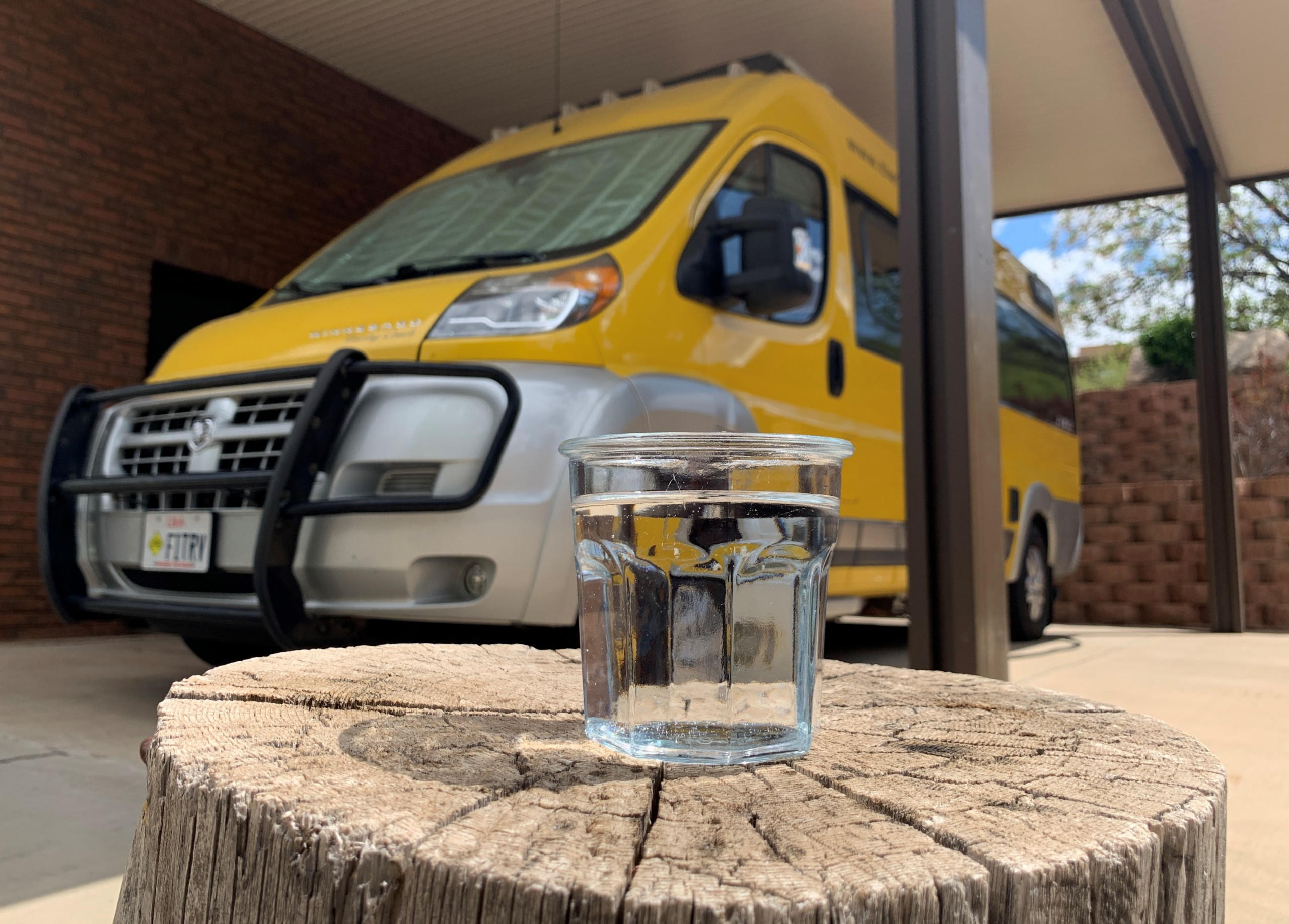
Stef and I actually drink the water from our RV’s onboard tanks and plumbing. We’ve always done this, and it’s never been an issue for us. We like that we don’t have to dedicate the weight and the space to bringing along bottled water. We like that there’s no bottled water waste. And we especially like that we’re never “out” of water. As long as there’s water in our fresh water tank, we’re good. I mean, we’re not as good as we are at home, where we have a Reverse Osmosis system to filter our drinking water, but we’re good enough.
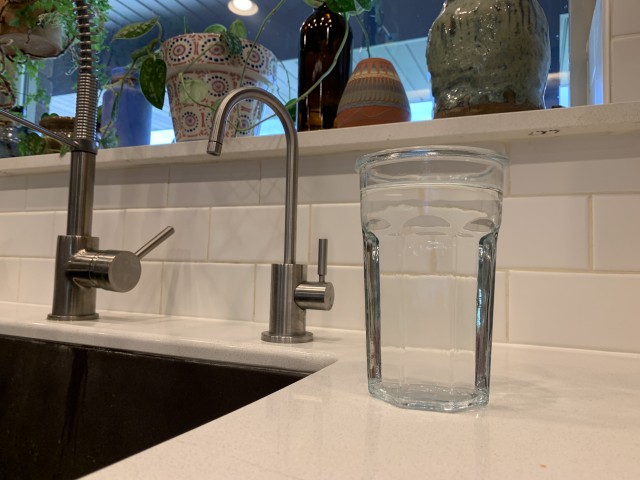
Best tasting water we’ve had.
There are a few things we do to keep Lance’s fresh water system running safely and tasting good. This pretty much sums it up:
5 Steps to Safely Drink Our RV’s On-Board Water
- Regularly sanitize the RV’s fresh water holding tank and plumbing.
- Don’t hook up to campground water. Ever. Use the onboard tank to keep the water circulating and fresh.
- Only fill the tank when we can be sure of the source. (This has led us to fill the tank with jugs of purchased water more than once.)
- Filter the heck out of any water before it gets into the RV’s water system.
- Filter drinking water a second time with an under-the-sink filter.
It’s number four that I’m going to talk more about now.
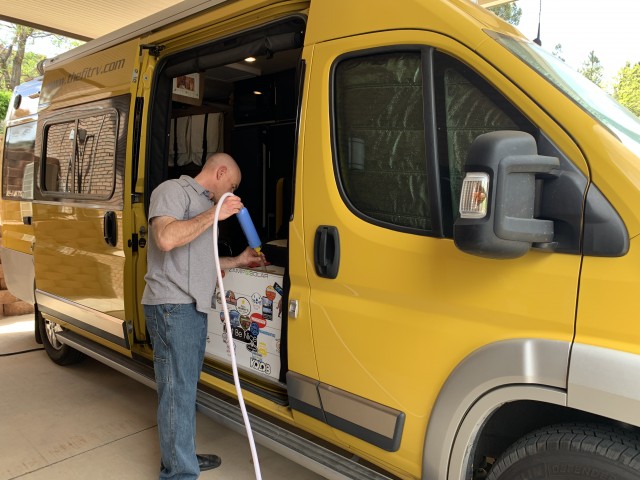
I also don’t usually fill through the side port, but that’s more of a winterization thing…
Like pretty much every other RVer I’ve seen, we had been using “the blue filter” for years to pre-filter water going into the RV. Since we never hook up to campground water, we didn’t use it like we see other people do. But we used it whenever filling the fresh water tank. It worked well enough, I suppose. I mean, nobody died or anything. But I’m always on the lookout for something better, and I think I’ve found it.
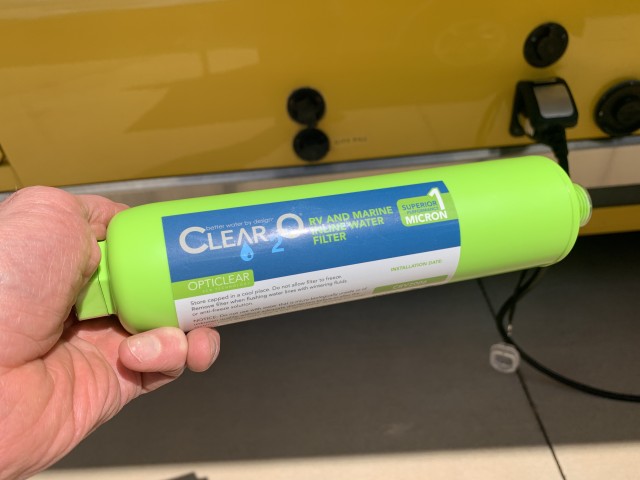
Our new water filter. I love the color. We certainly won’t lose sight of it!
We recently received a sample of the Clear2O inline water filter to test out, so we’ve been using that for our fresh-tank fill-ups. After doing some research and using it a few months now, I’m actually liking this better than “the blue filter” for a number of reasons.
1 Micron Filtration
If you read down in the specs on the blue filter, you’ll find that it claims to filter out particles down to 20 microns in size. That’s pretty small, but it’s still 20 times larger than the 1 micron filtration claimed by the Clear2O. Now, I haven’t independently verified these claims; I’m just taking them at their word. But in my book, 20x finer filtration is better.
Solid Block Carbon Filtration
The blue filters use granular activated carbon, which is cheaper to make. The Clear2O uses solid carbon block filtration. The difference in construction is pretty much what it sounds like, but there’s a benefit in performance. In a carbon block filter, the water can’t form channels and bypass the carbon – it’s in contact with more carbon for a longer time, and so more contaminants are removed. I like that.
It Can Start to Clog
Yes. Believe it or not, I’m calling that an advantage. Here’s the thing: Have you ever had a Brita filter and noticed that you could keep running water through it pretty much forever? It never stops! It’s the same with the blue filter. You’ll never know when those granular carbon filters have had enough, because the water can always find a way through. But a solid carbon block filter can clog – if not completely, then at least enough to slow the flow rate so that you notice. And when that happens, it’s a built-in indication that it’s time to change the filter. (Because let’s face it, even I don’t write the date on the filters when I start using them.)
A Couple Caveats
First, let’s talk about the flow rate. Being a solid carbon block filter, the Clear2O seems to have a bit less of a flow rate than the old blue filters. I don’t have a flow rate gauge, so this isn’t something I can quantify. But since we never hook up directly to campground water, it’s not that big of a deal for us. It’s not like I get bad water flow in my shower or anything. It just takes a few extra seconds when I fill up. If you use these filters connected to a campground water supply, you’ll want to pay attention to your filter and change it out when it starts to become noticeable.
Next, I want to talk about KDF. The Clear2O is not a KDF filter. The blue filters are. I’m greatly summarizing here, but KDF filter media is something that is used to prevent the growth of microorganisms in a water filter when it is in storage. Since we only ever use our water filter for a few minutes, and then put it into storage again, this is something I pay attention to. When I learned their filter was not a KDF filter, I asked the folks at Clear2O for storage recommendations. They recommended simply shaking out any excess water, replacing the dust covers, and storing the filter. That’s what we’ve been doing for a few months now. Our Clear2O filter doesn’t smell funky, nobody has gotten sick, and the water tastes good… so I guess that’s working.
A Taste Test?
I think the Clear2O water tastes better, but I could be kind of biased, right? So I wanted to conduct a blind taste test. I was going to gather a group of actual RVers and have them taste unlabeled samples of water to judge which tasted best. I headed to a meet up with new filters, sampling cups, and labels… and I even had volunteers ready to go! Then the whole world went on lockdown, and gathering people around to taste samples of water didn’t seem like such a smart idea anymore. I’ve still got it on my mind, though, and someday I just might conduct a taste test. When I get to do that, I’ll link it here. Until then – you’ll just have to take my word about it tasting better. Or, you could try it yourself and see.
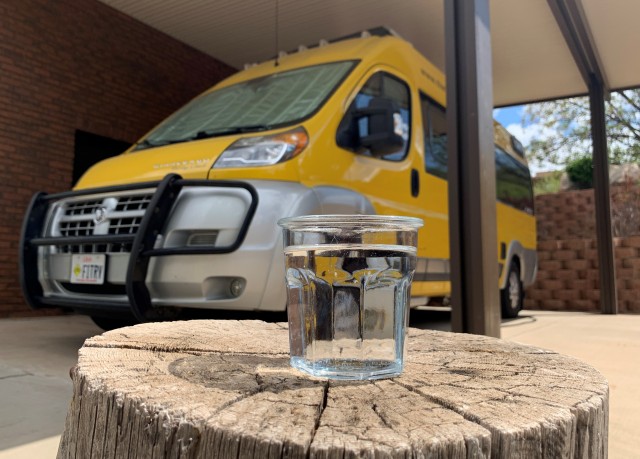
So that’s what we do as far as using our on-board water system for drinking water. It’s worked for us for years. What do you think? Do you drink out of your RV’s fresh tank or are you happy with bottled water? Is there some step you do that we don’t which might make our drinking water taste even better? What’s your protocol? Sound off in the comments below!






We have rented an RV and I bought a Brita to use to clean the water. Should we buy a filter, blue or Clear O2? I do not like buying bottles of water.
That depends on how long you will be renting this RV for.
As a rental, you have no way of knowing what the state of the water system is. If you’re going to have it for a while, you could clean and sanitize the tanks. Then fill up using a blue or CLEAR2O filter, and use the Brita for drinking water. In that case, you’d be right about where we are.
But if you’re only going to have the thing for a week, then you might not want to go through all the trouble.
It’s your call. An external filter, blue or otherwise, can help with the water coming in to the system, but on a rental, the system itself is a big unknown.
We don’t like pure tab water, we prefer lightly sparkling water, which contrary to the US, is very cheap here in Europe, like 1 US $ for about a gallon in 6 large bottles. For a 3 week trip we store about 8 Gallons, which is no problem as we have a 27 foot fifth wheel. Tab water in Germany and northern Europe, also on campgrounds is no problem, it is certified and one of the most tested foods here, so no worries. Southern and Eastern Europe is a different story. There, quality can vary a lot, most of the time it is not recommended to drink the tab water. So we sanitize our tank once a year before season start, but we don’t use an extra filter. In 30 years of camping, nobody got sick, so I am not planning to use a filter any time soon. Besides the issue of accumulating bacteria once the filter got wet for the first time, I fear that I would actually worsen my situation compared to not using a filter at all. And the sophisticated filter that James introduced here, is not available (yet) in Europe, to my knowledge. But in case it will be, I would try it. Thanks for the great research, James!
I actually like sparkling water myself. But you’re right, it’s not a “thing” here like it is in Europe.
Now if there was a way to have a sparkling water tank in the RV…
Can you clarify your points 2 and 3? Are you saying not to hook up to campground water because it may be a suspect source or because by doing so you don’t use the water in your fresh tank? If the latter, do you use campground water to refill your tank once you run it down?
Sure.
We don’t hook up to campground water (like, leave a hose connected) to keep the water in our tank moving and fresh.
We’re not opposed to filling up with campground water if we think it’s good.
But campground water isn’t always good. For example, at the campground at Laguna Seca, they warn you not to drink the water because it has arsenic. If we didn’t drink the water, we might use it to fill up for washing dishes, etc. There’s a campground in Elkhart where the water smells like poo… We don’t fill up at places like those.
Could you use the regular blue filter and the ClearO2 in series? That would prolong the life of the more expensive filter. Maybe?
Well, you could, I suppose. There’s nothing stopping you.
Although, I don’t know that the extra hassle would really be worth the savings…
Hi J-
You don’t seem to consider RV RO.
I wonder, you could have an extra 2 gallon tank and space for an RO filter…yes? In our terrible terrible water in Kalamazoo we waste one gallon of water for each one that goes into the reserve tank. And it just works off of water pressure, which you have.
-d
I’ve thought about an RO system for the rig, but space is at a real premium in Lance. If I had something slightly larger, I’d probably go the extra step of adding RO for drinking water.
J-
Yes, with you there.
That 2 gallon pressurized tank is hard to hide in a corner. (the filter unit is not so much space, I think).
For us, one possibility is in the empty space over and to the driver side of the rear wheel of our tandem.
Or, only use it in the summer and hang it off the bottom of the floor.
Cheers, and like the cheap gas with nowhere to go?
-d
Loving the cheap gas… just don’t need any! lol!
How do you regularly sanitize your fresh water holding tanks and plumbing? Do you intentionally try to maintain a measurable chlorine residual in your freshwater tanks? Do you take any special precautions when parked at home and don’t plan on traveling for several weeks?
In my opinion there are health benefits in periodically superchlorinating holding tanks and trying to maintain a very low level chlorine residual in the freshwater tanks. Otherwise your holding tanks and plumbing can become a great incubator. If you are removing organic contaminants from the water going into the holding tank (that’s what the carbon should be doing); then taste and odor issues due to chlorination by products should be pretty much a non-issue.
ps: I recently discovered your website. You and Stef have become one of my go-to resources for information and ideas. I really appreciate the humor and detailed videos. Keep you the good work!
Hi Bill.
For sanitizing the water system, I just use diluted bleach in water. I’ve tried a couple of the commercial sanitizing solutions and kits, and I always think they leave a weird aftertaste in the water. We’ve not made a video of sanitizing the tanks, but there are several out there you can follow.
I’ve never tried to super-chlorinate the system, and we don’t try intentionally to keep any kind of chlorine residual. The way we deal with that is by simply *always* using water from our on-board tanks. It generally keeps the water turning over often enough that I don’t worry about it getting off.
Now, if I was going to put the rig in storage for several weeks (as we’re done right now during this pandemic), I would drain the water system, blow out any extra water with compressed air, and run through the sanitizing process when it was time to fill back up. You can see this in our video on storing the RV during the pandemic.
The sanitizing really doesn’t take that long – I usually spread it out over a few days before we head out.
In the September 2022 issue of RV Magazine your article titled “Drink Up!” mentions that even “lead-free” fittings can leach lead into your water. This is true as I’ve discovered in my home drinking water. This was corrected by replacing my brass valves and fittings with stainless steel. I found stainless steel water regulators, but I cannot find stainless steel 90-degree hose entry elbows, wyes, or flexible water hose protectors with stainless ends. Any idea where I can buy these in stainless steel? I would like to do away with all brass fittings/connectors on my fresh water system.
Thank you!
I haven’t found a stainless swivel elbow yet. I think the best you could do there is find a plain stainless elbow and just hope it tightens up with the elbow pointing downwards.
Or, you could switch to a quick connect and look to something like this: https://amzn.to/3eDVvLJ It’s ABS, which is considered food safe. (But I’d still prefer stainless to plastic.)
If by “flexible water hose protector” you mean the little 6 inch hose bit they give you with the Camco water filters… I’ve solved that by just getting a 4 foot section of food safe hose. It’s longer than 6 inches, but I find I like the extra length. This is what we use: https://amzn.to/3DeuVTF
Thanks for reading, and good luck!