
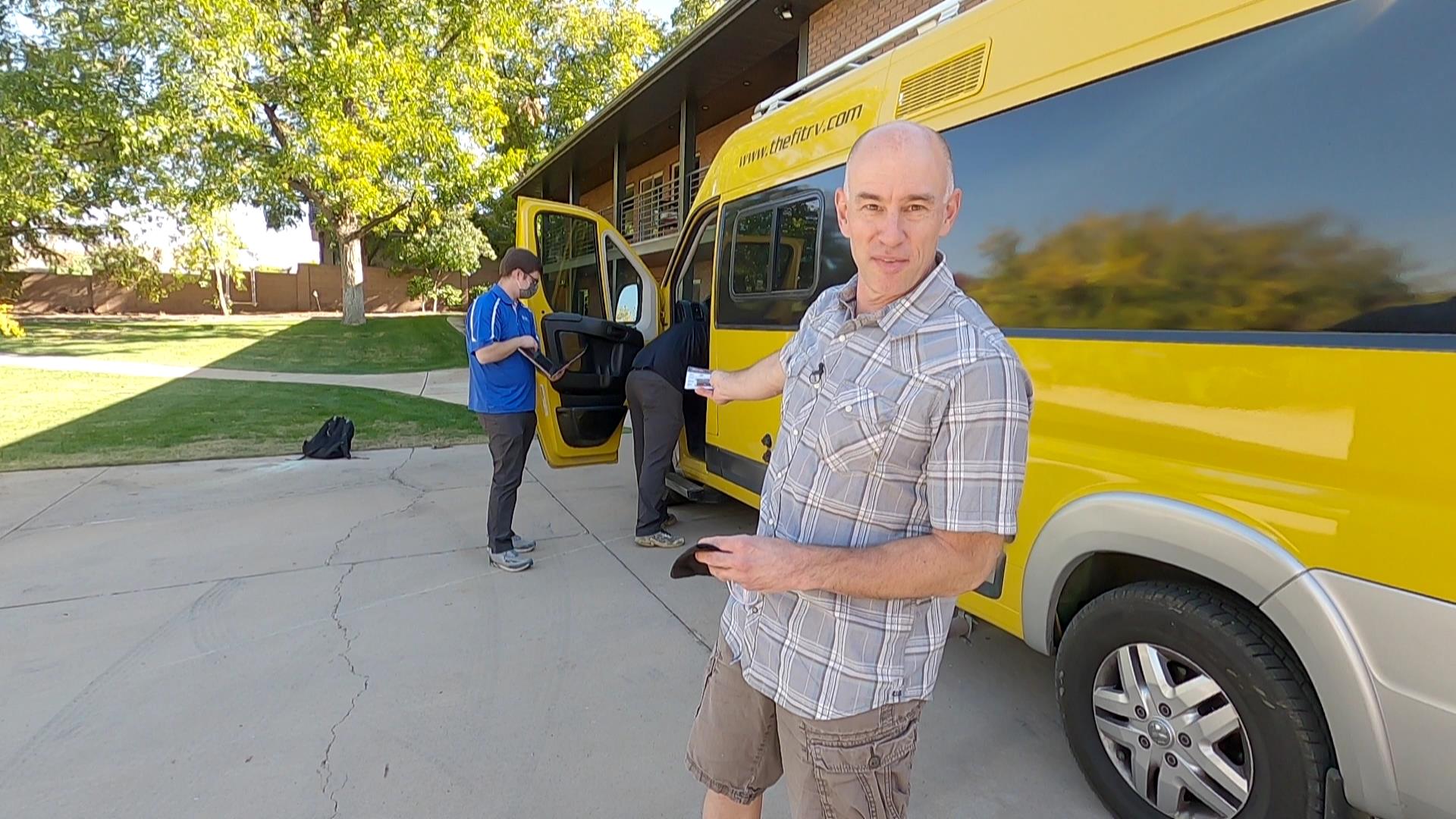
A few weeks back, I purchased and tested the Curt BetterWeigh. This is a small device that plugs into your vehicles OBDII port, and will allow you to “weigh” your vehicle without going to visit a scale. I thought it was a super cool idea. Unfortunately, I couldn’t get it to work properly, and I said as much in the video. Well, the folks at Curt saw the video, contacted me, and then sent out a couple of engineers to try to figure out the problem.
So put yourself in Stef’s shoes for a minute. I imagine her thoughts went something like this: “James was mentioning something about his van-weighing-physics-gadget and OH MY GOD NOW THERE’S THREE OF THEM and they want me to videotape them.” The end result is this video:
First off, I appreciate Curt sending out Jacob and Thomas to try to get to the bottom of the ProMaster /BetterWeigh accuracy. Especially since my initial review of the BetterWeigh wasn’t all that positive!
OK. Now, on to what happened. I’ll try to keep it brief here. If you want the full details, you’ll just have to watch the video.
- Curt had developed a new calibration for the ProMaster and built it into their app. We tried this first, but got inconsistent results.
- Next, we made multiple runs in Lance with the guys from Curt gathering data for later analysis.
- Then, we tried a new way to mount the BetterWeigh to rule out any mounting peculiarities as the source of the inconsistencies. (We were able to rule it out. The mounting change had no impact.)
- The guys from Curt then borrowed Lance for a couple hours gathering additional data to take back with them.
- After analyzing the data, they developed a new calibration and uploaded it into their cloud.
The data analysis and developing a new calibration took a while. Even when they were done, they told me that there seems to be some data inconsistency with ProMasters in general (and Travatos in particular). They warned me to expect some issues with the data. Armed with this, I tried to weigh Lance again with the BetterWeigh.
The newest calibration and app produced mostly good results, but occasional “way-off” results. You can see the actual process in the video, but if you look at the results on a graph, it looks approximately like this:
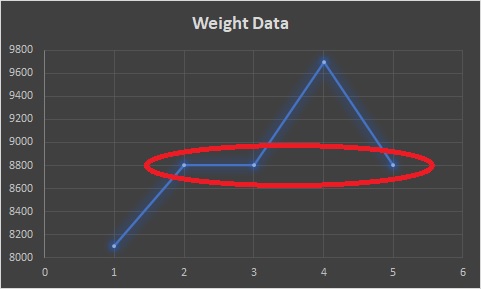
The red ellipse shows where the data is clustering around the real known weight.
So, if you know this, and are prepared to throw out the obviously inconsistent data, then it is possible to get a reasonable result from the BetterWeigh. At least that’s how it works in a ProMaster. It means you’d have to try to weigh more than once to be sure, but it CAN work.
This left me wondering if it was a problem only with the ProMaster, or if the inconsistent data extended to other vehicles as well. So, we tried again. The only other vehicle we had available right away was my Toyota Tacoma. It’s a 2018, and it’s not a terribly large truck, but it can tow, so it should be compatible with the BetterWeigh.
Unfortunately, we found that the Toyota Tacoma not only gave inconsistent results, but that none of these inconsistent numbers, even at random, had been accurate. (We weighed the Tacoma at the CAT scale. Probably the smallest thing they had seen all day.)
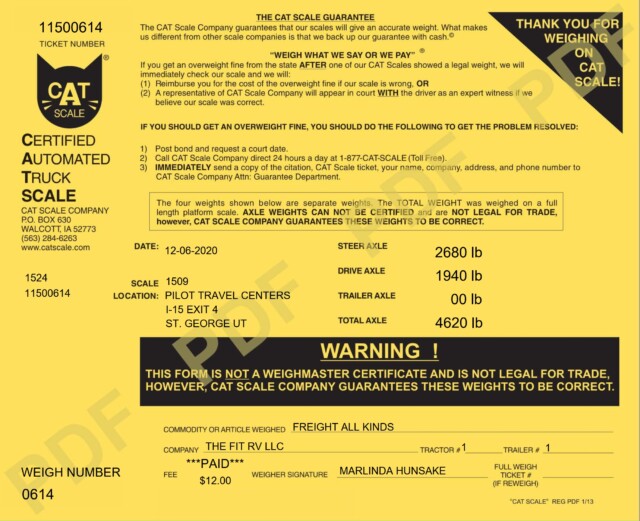
If you’re wondering what my Tacoma weighs, it’s 4620 pounds.
Not only were the weights way off, but the app was behaving strangely, which makes me think something was wrong. For example, the app made me “launch” twice each time to get a weight (instead of once, as in Lance). So I really think something was up with the Tacoma. Maybe they don’t have a good calibration for the Tacoma? Maybe there’s a problem with the Tacoma’s OBD port? I don’t know. I’ve fed this information back to the guys at Curt and we’ll see what they have to say.
Updates From Our Field Tester!!
Jacob and Thomas had left me with another BetterWeigh, which I passed on to one of our readers, Dan, who agreed to test the BetterWeigh on a different rig (his LTV Unity, on a Sprinter). Here’s what Dan reported back:
Hi James:
Thanks for sending me the BetterWeigh module which I received on the 19th.
After spending the good part of the afternoon yesterday attempting to pair the Bluetooth, I was about to call this device the “better – no way”. But after I deleted the app from my iPhone and reloaded it, it worked just fine.
To educate myself, I tried it on my F150 which I weighed last June on a Cat Scale. For some unknown reason to me, the correlation was terrible with the BetterWeigh. Again, I was about to abandon this “not-better weigh”.
However, the BetterWeigh worked exceptionally well with my LTV Unity Sprinter (see photo).
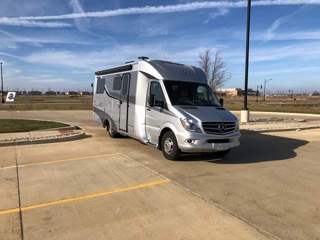
The average of 31 tests was 10,439 pounds compared with the Cat Scale weight of 10,415 pounds (see spreadsheet). This was a mere 0.2% difference. Also the variance of the test data was less than 5% which is acceptable considering that the rate of acceleration was provided by a human.
Today was fairly windy with winds in the range of 24 to 34 mph from the west. My premise was that wind should add to the demand on the engine torque and thus heavier apparent weights should be measured when driving into the wind. However, I drove north, south, east and west and couldn’t discern a trend.
Another factor that I investigated was the road quality and surface. Three of the roads were asphalt country roads (see photo) while the fourth (Fields Drive) was a new engineered concrete surface. Data points 23-31 were remarkably consistent for the concrete road.

In any case, I am satisfied with the experimental results. Please share them with whomever.
Merry Christmas
Dan
Daniel P. Abrams
Emeritus Professor of Structural Engineering
University of Illinois at Urbana-Champaign
Final Thoughts
So, is it a substitute for a “real” weight at a certified scale? No. Even working properly, the BetterWeigh only claims to be accurate within 5%. Depending on your rig, that 5% could be greater than your OCCC. But can it provide a useful rough approximation of your rig’s weight? Yes, potentially, depending on your vehicle. I suppose that’s a suggestion for Curt. Maybe they could post online somewhere a list of the vehicles they’ve calibrated and how many samples they’ve gathered for that vehicle. That could help a potential purchaser decide how well it might work for them. Given the dedication they’ve shown to getting this thing right, I have to imagine that if it doesn’t work for your vehicle, it can be made to work. This is the kind of product I could see getting better over time as they gather more data and more vehicle calibrations.
Anyway, that’s it for the Curt BetterWeigh.
Cheers!






Been following this Curt thing and thanks for posting the follow-up and reply and working with their guys.
A lot of us want this thing to work. It requires accurate measure of torque, and accurate measure of acceleration, and a hardware/software interface that i us solid to the science and with a decent user interface. I a also an embedded developer and I could see the struggle on the guys face and appreciate their struggle but its just not there yet. I hope Curt continues to fund this development and maybe a rev2 of this design might work.
Not an easy task, to be sure.
Perhaps it would work better if the Curt folks would re-design the interface of the app so it can show the throttle position on a nice graph to show the user *exactly* where it is during testing so they can make sure to hit that correct position every time?
I mean, every ODBII reader/gauge I’ve ever used had a nice “throttle position” sensor display so I’m sure this can see the same thing.
Big difference between what the user thinks is half-way down versus what the ECU – and thus the BetterWeigh – is actually registering.
Hey Guys, just saw this post/video. Extremely disappointed is all I can say in terms of your results as I had high hopes for this product. We had been seriously considering this item after I had read an article about it and saw some of their advertisements. I love the concept and idea, but I trust your real world testing. We have a Chevy Colorado towing a small travel trailer. The variable for us is the constantly changing weights from a payload standpoint as the one consistent for us is the rig setup with my wife and I. The weight changes depending on where we are going (full hookup v. primitive, etc.), who we are camping with, and the activities involved. Thus, the Curt would be perfect because it is impractical to run to the scale after we load for each excursion. Reliability is the key and we’ll be very interested in any potential follow-up information – even if we are too late for being the crash dummies . . . . .
I just received an update from our tester. He had somewhat better results than we did. I’ll be editing his response in shortly.
James, you are a patient man. Thanks for suffering for us!
Love that you are trying to figure this out. However, given the time and uncertainty With the result, It does seem the CAT Scale would be the better choice. That said, Newton wasn’t wrong so it has to be in the data or how they are measuring it so I would love be part of figuring this out. Plus it sounds like fun. I have a 350HD Transit based Sportsmobile at the ready…
Ooohhh… I like the idea of a Transit.
I’ve just offered the BetterWeigh to Dan.
If he’s unable to participate, you’re next in line.
I have zero experience with RVs, but I bought a HaulGauge when they first came out, then had to delay purchase of my “tow vehicle” for a while (my previous vehicle was a manual (no torque converter slip data, so no workie of course)).
When I installed it in my Honda Ridgeline it wouldn’t give me any results, just said try again. Tech support eventually sent me a new one, which by then was called BetterWeigh. This one worked fine, and has given reasonable results with their calibration. In repeated weights, it gives a range of about 15% either way. I weighed myself at a CAT scale once, and it was only off by about 6% from the average of two BetterWeigh weights while towing a trailer of about 4800lbs.
Overall, for my Honda, if I take a few readings I can place some trust in it, within reason. I never plan to require more exact numbers for my utility trailers or equipment trailer, so that’s an ok result, but I think that’s about the limit of technology currently.
For fun I tried it in my wife’s Subaru, and it surprisingly had a calibration and gave a reasonable weight with her CVT.
We never thought to try it in the Subaru!
Sounds like your final conclusion is the same as ours (for the ProMaster anyway): if you run it a few times, you can get some confidence. But it’s not super exact like a CAT scale.
Indeed, we are in agreement. I almost think the software needs a mode to take 3 readings and give you a better result. It’ll never be like a real scale, but it has definitely helped me figure out what my vehicle and trailers like and don’t like, and how things feel at different weights.
I’ve also tried the payload and tongue weight measurements. These just measure how much the truck squats to the rear, but with an evenly distributed payload (I tried a load of dry firewood I was delivering to friends) it does seem useful. I have a weigh-safe tongue weight scale on my adjustable ball mount, and the BetterWeigh was reasonably close in two instances, but very light on a third. I didn’t have time to try it again, but I’m guessing running the procedure a few times would reveal one wonky weight. For practical tongue weights of course I just look at the scale on my mount.
James, I was hopeful that the engineers found an easy solution for you. I’ve tried use the Curt unit to measure tongue weight on my trailer. Widely off the mark. Just as unreliable as your efforts were.
Called Curt and the rep told me to download the latest app and he would call me back after talking with the “experts”. Never got a return call. At least you got two engineers and a free unit!
I’m in. Sprinter Pleasure Way Plateau TS.
If everything falls apart, I’ll help. LTV Unity MB (24.5’ Sprinter)AND Storyteller Overland (19’ Sprinter) – both 2019 models. How is that for a head to head? Cheers! Cb
I wonder if the load of the alternator, and if you have a second alternator would be affecting the readings. If it is charging a battery with a heavy load, then changes to a float charge, it will be changing the load on the engine. 2600 watts is a far amount of a load.
I asked them about that, as Lance does have a lot of mods, and the alternator taking off a bit of power kind of makes sense.
Their reply was that only a very few things directly involved in delivering power from the engine to the ground would have any effect. The wheel and tire sizes, the torque converter, those kinds of things.
It seems they are a long way from
Step 3 … Profit
And we have a winner for BEST COMMENT OF THE WEEK!!!!!
I’m not sure how many FitRV followers would also know about the Underpants Gnomes from Southpark.
Maybe not a lot of the followers.
But both of the writers do!
This product was originally developed by a company named “Haul Gauge”, which was recently purchased by Curt.
I purchased a Haul Gauge in 2019 and had very similar experiences…varying and inconsistent readings. I spent quite a bit of time working with a Haul Gauge engineer to troubleshoot my readings to the point where HG refunded my purchase to offset my time investment.
This is a neat concept, and I hope Curt can get the bugs worked out.
We have a 2016 Airstream Interstate on a 2016 Mercedes Sprinter 3500 170 EXT, and would be delighted to give the Better Weigh a try. Can’t say our RV is stock at this point, but I can certainly commit to actually weighing Rocinante Piccolo on a CAT scale so we can compare what this gadget says with what the scale says.
I have a 2016 Leisure Travel Van with a Sprinter chasis and would be glad to add a data point. I am a retired structural engineering professor and could report on research data competently, though perhaps not as well as you do.
Probably too late to the party but I have a new 2020 Winnebago Boldt (so the Sprint 3500xd chassis). RWD.
From what I know in your review of the Boldt is has one of the largest CCC of a class B in the 2600lbs range, so maybe that’s relevant to this?
I haven’t decided where to send the extra BetterWeigh yet.
This is definitely in the mix.
It seems clear that this thing should not be for sale yet, as it is clearly not beyond beta testing. It is completely inconsistent and unreliable and is, in a way, something that could contribute to unsafe operation of a vehicle based on false data.
I have a brand new 2021 Revel with nothing loaded in it yet. I can try it out.
That’s a tempting one. No mods, fewer variables.
I’m in … 2019 ERA 70B named Wall-E Winnebago
James – Please consider me as a candidate for your test. We have a 2005 Roadtrek 190 built on the Chevrolet Express 3500 chassis.
Thanks,
Mark in Colorado
James — I have the Haul Gauge version which appears to be the same thing as the screens are identical. I have 2020 F350 and tow a 25 foot Airstream.
I have owned the truck for a year. They have still not published a calibration for it and require manual calibration. That is bizarre that, after all this time, they cant figure out a calibration for one of America’s most popular towing vehicles. I have manually calibrated it and it does not weigh properly. I no longer use the device and, it certainly was not money well spent. The idea and the physics behind it are very exciting. It should work but it does not. Even if I could get a proper weight now, I have lost all confidence in the device and would not rely on it for anything. On the next trip to the storage lot, I will remove the device from the truck and put it in the garbage.
That’s interesting. When the guys arrived, they were driving an F-150, and they commented that the calibration for that was rock solid. Strange then that the F-350 doesn’t have a good calibration.
2020 was a major model upgrade including a newly released 10 speed transmission. That said, the truck in the diesel version like I have is hugely popular for towing as is the F250 which almost certainly does not have a calibration either and the engine and transmission are identical.
James, Love your videos. I have a 2017 Winnebago View that I just had weighed at a Cat Scale and would love to test out the Betterweight for comparison.
I read this as part of a review on Amazon:
one tip: if you don’t see a screen asking for the orientation of the betterweigh during level function: go to apps, delete the cache and files, uninstall the app, restart, reload the app, connect betterweigh, then go to change vehicle, then do the level, then do the calibration.
This thing isn’t even half-baked. I already endure being in a permanent beta test of the LCI One Control system that runs my entire RV. No thanks.
Seems like you shouldn’t have to delete and reinstall the app every time you change vehicle.
I’m waiting to hear back from Curt. Maybe that’s really a thing. Or maybe there’s just some issue with the Tacoma.
In all the testing did you try a different make/model of phone?
Elusive points of failure are what feed engineer’s nightmares!!!!
Yes. The Curt guys had a different phone.
(Good question though.)
I’m reminded of what Kevin O’Leary from Shark Tank says of a bad product he says you need to take it behind the barn and shoot it. It sounds like me they just have a product that doesn’t work.
If you would like to look at a truck and trailer combination we have a Ram pickup with an 32’ travel trailer. It would be interesting to see if the Ram pickup has the same noise that the Promaster has. This would also give so insight into the truck by itself and then the truck and trailer combo. I would be willing to do both the truck and then the truck trailer combo. This would allow for double the amount of data points. Love your video by the way!
Is the average RV owner so obtuse that he or she does not have a clue as to whether or not their RV is carrying weight above and beyond it’s capability? I think not; but this assumption is why products like these are able to find their way into the marketplace. A good rule of thumb is to not travel with an excessive amount of bricks and lead weights in your vehicle. For most people who have a nominal amount of intelligence, overloading is not an issue, but for those who don’t, this product will not be of any assistance.
Some smaller RVs come with surprisingly little cargo capacity. Occupants and water could overload them.
There are a lot of rv’s sold with more storage then they can safely use and some with unusably low OCCC. Tiffin’s wayfarer class c comes to mind as one of the worse offenders. You can overload certain floor plans just by putting two people in it and filling the fresh water tank. Even on more reasonable rv’s its still fairly easy to overload if you have a family or are going on an extended trip.
Seems pretty hopeless, both from watching this and a quick scan of reviews. I’m guessing it takes the engine performance data from the OBD2 and calculates how much force is being applied, plugs that into m=F/a and there’s your mass. But the engine sensors aren’t made to do that so they’re not sensitive or consistent enough.
HI! I have a 28’ class A that weights about 21000 lbs. Its a 2102 Tiffin Breeze Diesel Pusher. I would be happy to do the tests and return the module or pass it onto the next person on your list.
I’m a data oriented retired engineer kind of guy so I am all about the details of performing the tests correctly and would be happy to take pictures of the results.
I’d be curious to know if the BetterWeigh even has calculations for diesel pushers.
That’s a very different animal. I’ll ask them when I hear back.
I’d be willing to run the tests and weigh my RV. A Winnebago View on the Sprinter chassis.
However it is currently in the shop for repairs so it will be 2 or 3 weeks before I could test it.
Before you moved on to the Tacoma, I was wondering if part of the variance problem with the Travato/Lance would be the extra sloshing from the water tanks. But… ProMaster problems in general, and the wacky Tacoma numbers… oh, well.