
Where does the time go?
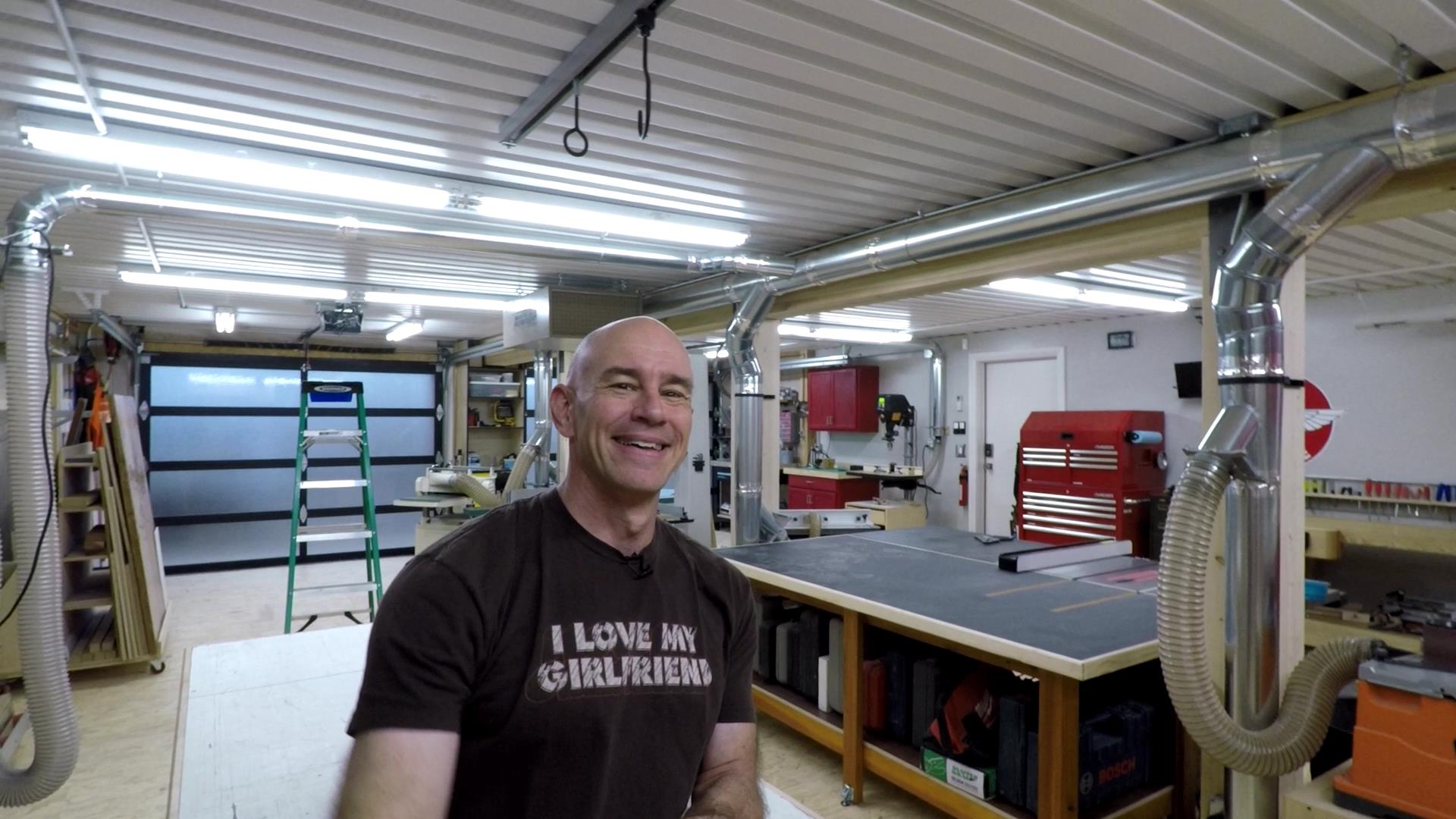
It’s been just over one year and one month since I started on my quest to turn our second garage into my awesomest-ever shop. This past Saturday, on December 7th, 2019, at 1:42 PM… I finished. Watch the (rather long) video below to see what I got done… and to watch my wardrobe change from shorts to jeans as the seasons turned on me.
It might be helpful to take a look back at the mess (and scorpions!) I had down there when I started. Click on this picture to go back to the very first video of my junk-filled mess.
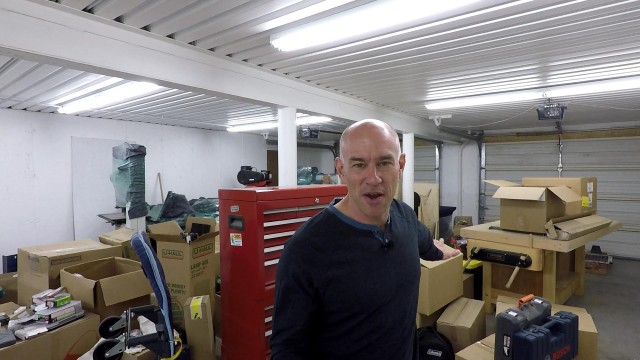
Thankfully, things are very different now. Here’s a quick rundown of the projects I got completed in this video:
I built a new drill press table.
The design was a compilation of a bunch of things I found on YouTube, adapted to my drill press. I like it so far.
I installed a compressed air system.
I went round and round on what materials I wanted to use. I had black iron pipe in my last shop, but this time around, I went with copper tubing. I won’t lie – it was mainly because I like the looks of it. It actually wasn’t THAT much more expensive for the copper. Where I did spend some money was on the ProBite push-to-fit fittings. These are very similar to the SharkBite fittings you may see at your local home center (or on Amazon). I’ve used the SharkBite fittings on plumbing projects (and in the RV) before, and they are totally fine. But when it comes to compressed air, there’s a difference. You see, the ProBite fittings are proudly rated as A-OK for compressed air – SharkBite are not. So that’s why I went with the ProBite on this project.
But besides the compressed air thing, there were other advantages to using push-to-connect fittings on this project. I can disassemble the fittings if I need to, and they swivel even after they’re complete (which makes them a LOT easier to assemble than threaded or sweat-on fittings). Yes, they were a bit spendy, but I don’t regret it. Also, I bought quite a few parts from Rapid-Air. I didn’t use their compressed air tubing, but I really like their solid aluminum outlet blocks and drain valves to go in them. No regrets on this compressed air system at all.
I built an outfeed table for the table saw.
In my previous shop, I had an HTC roller outfeed table that worked pretty well. But it took a couple extra steps to use, and required me to drill holes in my table saw. I wound up selling it with my old saw. This time around, I wanted a permanent outfeed table, and so I built one… twice. On my first attempt, I had a mishap with the laminate top which ruined the whole thing. I had to throw away the three-layer built-up top and start again. It was a sad day. There were tears.
But eventually I got a new top built and the table complete. Loving it so far on the back of the table saw. (Plus, who doesn’t need another table in their shop?)
I installed the dust collection system.
This was the biggest job in this video. It was also the one I most dreaded doing – because I remembered what a royal pain in the butt it was the last time I did it fourteen years ago. Of course now that it’s done, I love it! Completing this project involved getting a duct system design from Oneida – who sold me my dust collector those 14 years ago. They didn’t charge me for the redesign (the original design service was used on my old shop), so I liked that. In the end, I wound up cutting 30% of my fingers, 50% of my palms and 100% of my heads with sheet metal. I was fully expecting to amputate something with a piece of sheet metal, so those numbers are actually pretty good.
The ducting is run with 26 gauge snap-lock pipe. The pipe is taped and sealed with silicone where appropriate to make sure it doesn’t leak. Probably the coolest part of the whole system are the hangers I used. They’re a product from “Gripple”. You can see them here at this link, in addition to in the video, so you get an idea how they work. They’re kind of like zip-ties made out of cable.
The last thing to complete with the dust collection was to cut a hole in the closet wall so that I don’t pressurize the closet when I put doors on it. In my last shop, I had the return air from the dust collector routed back inside the shop to keep from pulling air back down the chimney. If you think about it for a while, it makes sense, but I do a better job describing it in the video.
And I finally completed the last little bit of trim.
I was going to build closet doors in this video. But then I realized a couple things. First – the video was already going to be more than 20 minutes long. Second, building doors is a woodworking project! So, I bailed on the doors, and just trimmed out the closet opening that had been staring at me all ugly-like since I first put up the walls. It looks a lot better now, and I know exactly what dimensions I have to work with for building the doors.
And there you have it. I’ll do a proper shop tour video at some point in the future, but until then, I’ll probably be working my way down Stef’s 13-month-long-list of “honey do” projects.
I guess I don’t really have any more excuses…









The dust monitor would work well for a dust collector system I’m putting in. Could you list where you got it and who manufactures it. Thanks!!!
Here you go! https://amzn.to/3ErE1tO
Wow James. Thats a great shop. Move over Norm, LOL. So the first project you should show making the doors for the dust cabinet, not just show them when they are done, show how you do them.
oops… They’re already mostly done!
It’s a fine line though. I know there are folks that are genuinely interested in the woodworking. But The Fit RV is, at its core, about RVs and the RV lifestyle.
I included the shop build because people will inevitably see it in our videos, and they’ll have questions. (And also I want people to know what I’m doing when there are big gaps in my RV content!)
But I don’t want to morph this into a woodworking site, or to turn away folks looking for RV content.
Glad you’d be interested in my woodworking though. Maybe a spinoff site and channel?
Understand this sentiment, but I’d suggest a different approach. At their core, I find most RV’ers and people who live that lifestyle are self-reliant DIY types of personalities. I’m sure many of your mods are the most heavily trafficked videos. Thus, I would say many of your viewers ARE interested in your woodworking and other projects. So long as you label them accordingly, people who are not interested don’t have to watch. Those of us who enjoy them can continue to do so. Besides, more Steph and James, in whatever form is always a good thing.
Finally, “. . . I actually like did the calculations . . .” Of course you did, thanks for the chuckle.
Most of the fires I’ve been to were traced back to sanders producing sparks. One shop had changed their process and hit small brads embedded in wood. Several other fires were caused by sharpening tools on belt sanders. A couple of other fires were older machines that were loosing a bearing.
Fortunately, most were small nuisance fires that just smelled up the shop.
Wow, that is fantastic working space Jim. I could only wish to be as organized as that!
Beautiful. Square footage of the new shop?
25×36
You did a hell of a job James.
Thanks!
(Took me long enough… lol)
So cool to see the shop complete! I thank you for the sawdust we made together and for my one minute of video fame. You might consider a new lock since I know where you live. Congrats, James! That is one spectacular workspace!
Thanks, amiga!
James I have been a woodworker for many years, furniture, cabinetry and just stuff. I commend you your shop build it is absolutely beautiful and ergonomic ( if that’s the way to say it ) anyway I think it’s freakin awesome. I had a compressor fail do to internal corrosion some time ago. When I replaced it, similar to your size I added a automatic bottom blow down valve, you be surprised how much moister comes out, not much but enough. it’s called drainmaster from dynaquip controls. Again great job my friend, boy would I love to be your neighbor
I thought about an auto-drain for the compressor, but decided against it. I’m pretty diligent about draining it every time it runs. It’s not a heavy use tool for me, at least not every day.
And I haven’t had any neighbors come by… yet…
James – what’s the deal with the doll head on the compressor?
LOL!!!
I forget that it’s there. Funny you picked up on it.
It’s an artifact! When I was painting my last shop, I unearthed the doll head. I didn’t really know what to do with it, so I cleaned it up and stuck it on one of the ball valves in my compressed air system.
It managed to make the move along with me, so I put it back in place.
(Plus, on at least one occasion, it’s prevented me from cutting my head on that valve handle…)
Great shop! Did you run a ground wire with all that duct work or do you think it is even necessary?
Thanks!
Never considered grounding the ductwork in my shop. You usually see the grounding warnings for PVC systems, which can build up a static charge. My ductwork is all metal (except for the final couple feet to each tool).
Even when ductwork is grounded in a home shop, it’s typically more to guard against the annoying static zaps than against any real fire danger.
In my last shop, I never got so much as a static tingle from the metal ductwork… and I was in that shop for 14 years.
James,
Fireman here.
I work in an industrial area with a number of woodworking shops and a common problem is a spark generated in a wood working machine that is sucked up in the dust collection system. While the most concerning thing would be a dust explosion, (i’ve never seen one) the most common thing is that the dust hopper catches fire and it damages the dust collector (I’ve seen a bunch of these). Most of the time, the fire is pretty small at first, but if it spreads to the exhaust filters it can extend beyond the machine.
On and industrial scale dust system, an automatic sprinkler system and internal smoke detector are the best choice. On a home system, I’d recommend that a simple home smoke detector near the dust collector’s exhaust would provide you and early warning if you have a problem. The detector might need to replaced when it get overly contaminated with dust, but would provide cheap insurance.
Hope it helps,
Cameron
Thanks. I’m always keenly aware of when anything gets into the dust collection system that might be even a little warm. But – there actually IS a smoke alarm in the shop.
(I’m also about the only person I know who cleans his dryer vents.)