

Caravan Salon in Düsseldorf is a big toy store for RV nerds like me… and the world’s biggest toy store at that. And like any kid in a toy store, I found it easy to get distracted and overwhelmed, and start running back and forth from one end of the mile-long show to the other dragging mom (Stef) behind and demanding ice cream.
But after the initial “shock and awe” wore off, I decided to put together something that shows typical rigs from each of the classes of RV that our readers might recognize – and from one class that they won’t. The result is this video:
The clip pretty well speaks for itself. You’ll see typical rigs from Classes A, B, and C, and you can form your own opinions about those.
But it’s the fourth type – the class that’s missing here in North America – that I want to talk about in more detail. Technically, by RVIA standards, this would be a Class C. At the show, we saw this being referred to as a “Compact”. So let’s call it:
“The Compact C”

I had actually been calling it a “C-minus” for a while, but they tell me that’s a terrible name for marketing purposes…
What I’m going to do now is to outline some of the features of the Compact C, and try to convince you why it’s awesome. If you agree, then we can all start bugging our North American RV manufacturers to build one.
- The Compact C is built on a cab chassis, like a regular Class C, but it is NO WIDER and NO LONGER than the Class B counterpart that would be built on the same chassis. In fact, the Compact C you see in the video is actually *shorter* than our current class B, Lance. What this means is that the Compact C enjoys 100% of the maneuverability of the class B. There is no B/C tradeoff here. They are identical in their ability to get into parking spaces, tight corners, parallel parking, etc.
- Since the RV manufacturer is making the walls ceiling and floor of the Compact C, they can all be much better insulated than a class B. The walls we saw were vacuum bonded with insulation inside of them.
- They could also have double floors, providing an air space for wiring, plumbing, and ductwork below while keeping the interior warmer. Most models we saw also had heated garages.
- There are no automotive bits, ribs, supports, or channels to work around in the Compact C. So things like giant garages, elevated beds, square man-doors, double-paned acrylic windows are all much easier to include in the design.
- The Compact C can be taller than a regular class B. Tall people rejoice! Besides allowing more headroom, this means bigger showers, and additional space above elevated beds.
- Square walls make it easier to mount deeper cabinets, and generally make the rig feel much more spacious inside. Even though the length and width are the same as a class B, you can’t mistake the feeling that the Compact C is just “bigger”.
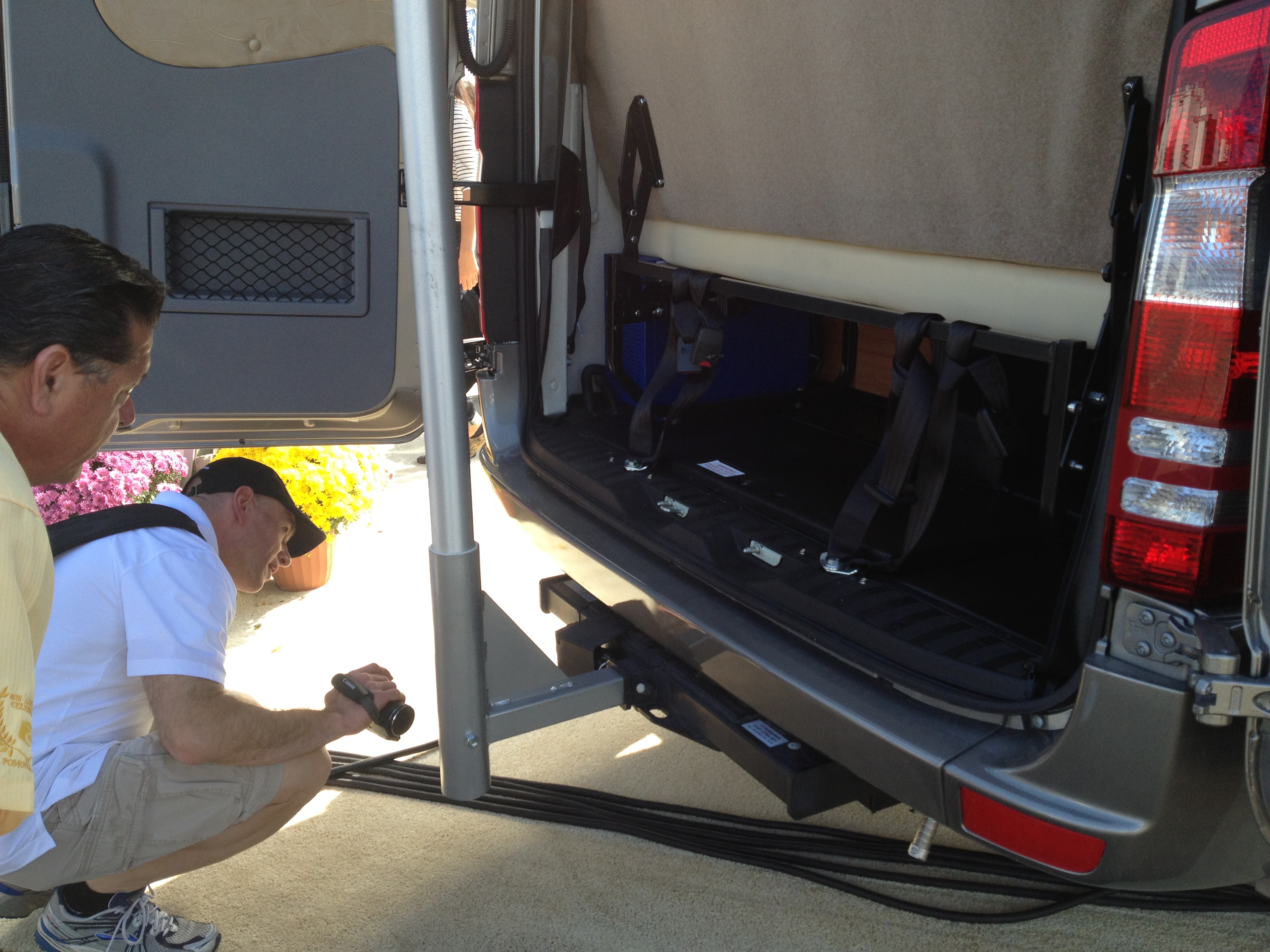
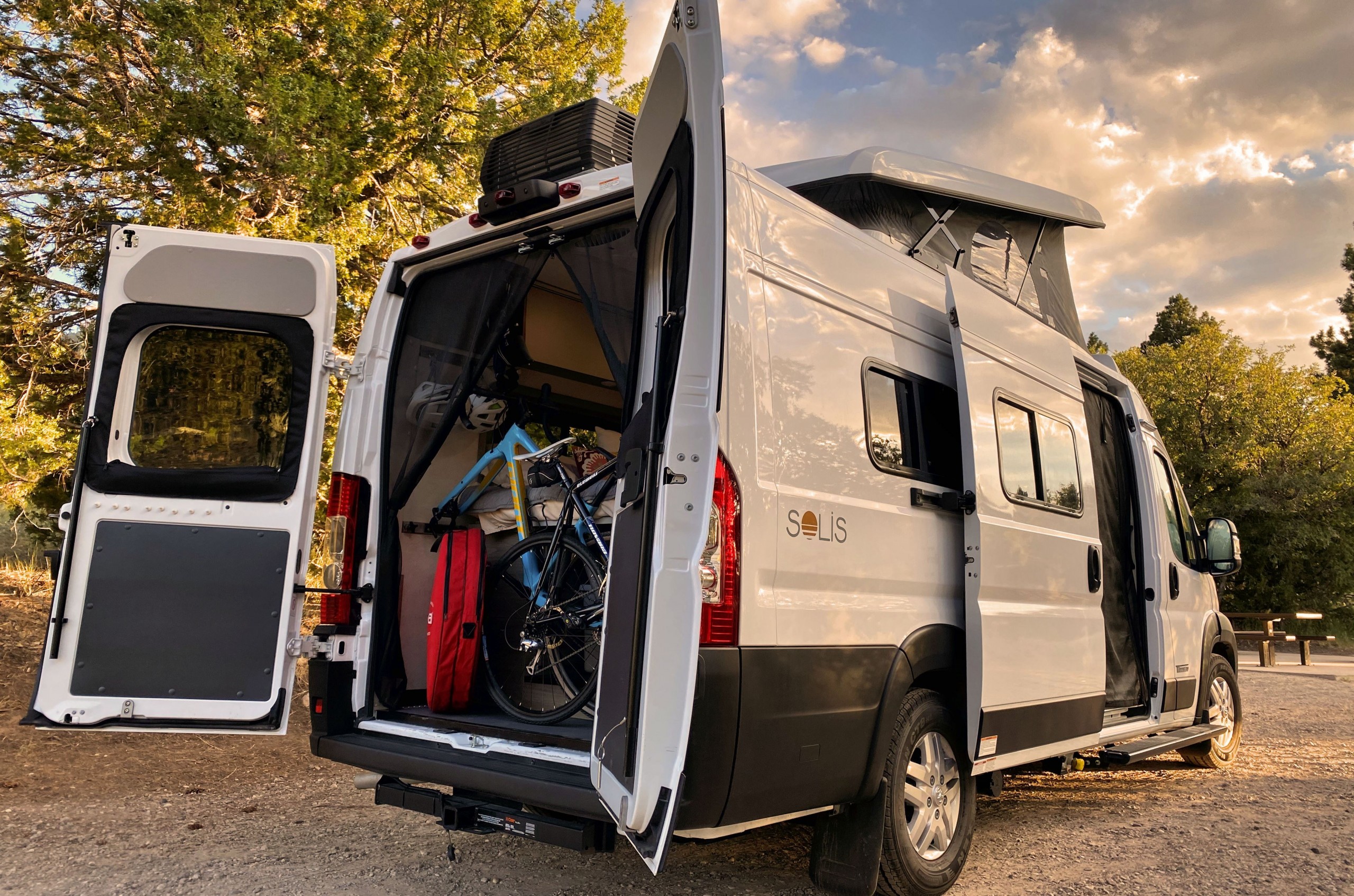
- Unlike a B van, a Compact C has a gear garage! For RVers like us who haul gear and toys (like bikes!) and who also want to stay small, a gear garage would be awesome.
- Since they can be built as a traditional Class C (rather than everything being carried in through the doors like a class B), they should be less expensive to build.
- And maybe this is just because I spend so much time up there, but I like that you can walk on the roof of a Compact C without denting it!
The only possible negatives I see with the Compact C are the inability to go “stealth” and the potential to hit lower hanging branches. As far as “stealth”, I’d argue that a typical North American class B isn’t stealth in the first place, so you’re not losing anything. But the greater vehicle height is something that you’d just have to get used to.
So what do you think? Am I off my rocker here? Stef and I would love to see someone build and offer this class of RV on this side of the Atlantic. If you agree with me (or even if you don’t), sound off in the comments below!

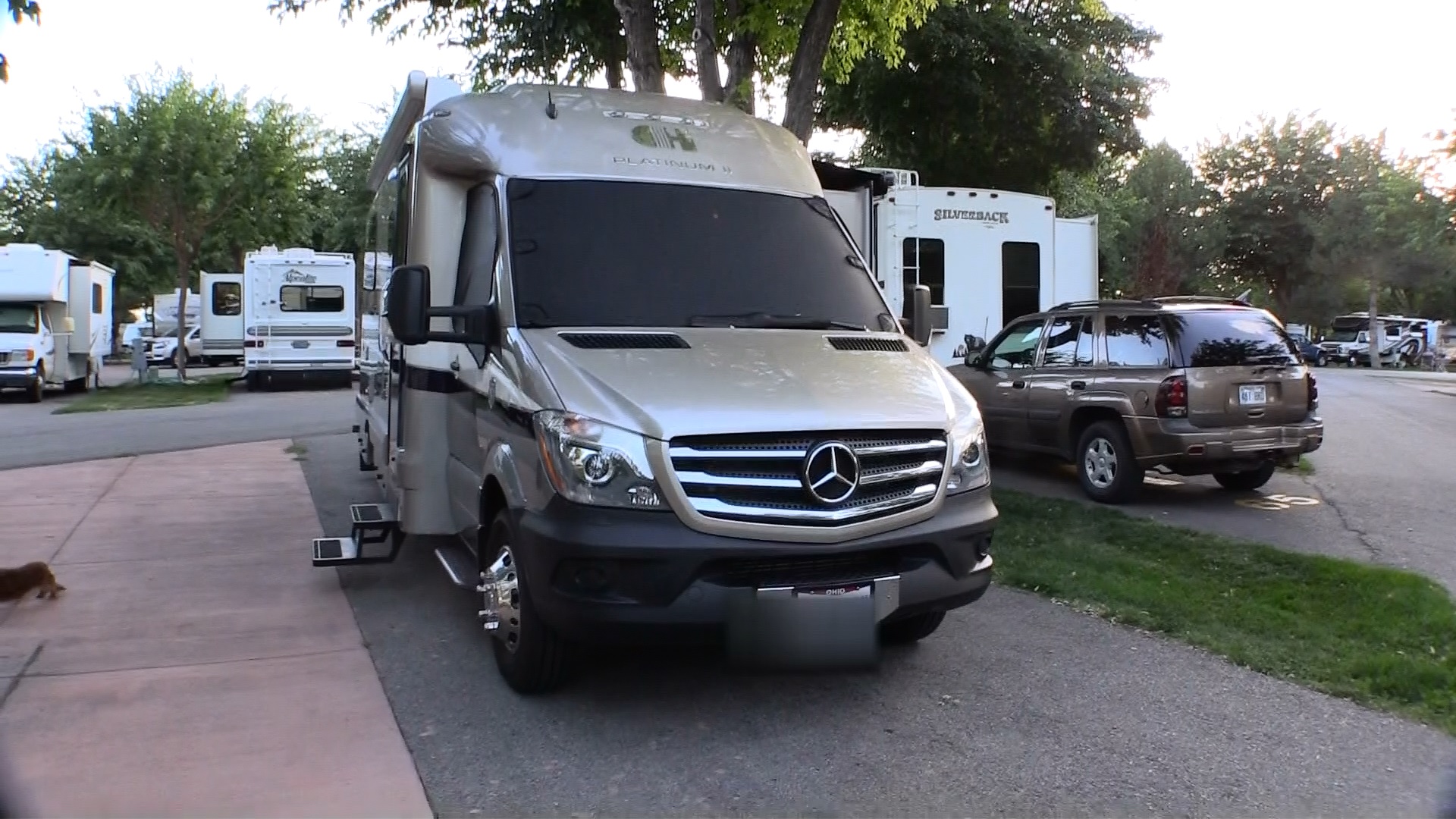






I was hoping to see you review a Hymer MLT or other ML series unit with the L-shaped lounge and big garage. I’d like to see that layout available in the U.S., along with the lithium voltstart+solar package and cassette toilet. It seems like that would simplify systems management and maintenance.
Hi Stefany and James, I am learning a lot from your videos. Thanks for making them! I responded to Matt’s comment from Germany, and I also wanted to see if you would be able to advise me on an RV that might be comparable to the Winnebago Trend, in Europe, as I am interested in buying something when I go there next month, for a 7 month stay. Thank you!
Pretty much all the RVs in Europe are just about “Trend-ized”. And they’re just about all based on the Fiat Ducato, which is a ProMaster (basically).
You’ll need to be sure you can drive a stick shift, and likely a diesel, but darn near any European rig would fit the bill… seriously.
But the roads are going to be *considerably* more narrow than you’re used to. You might give a second thought to renting a Class B while over there.
I know if we went back, that’s what we would do.
Australia has a C RV on a B chassis. https://www.youtube.com/watch?v=xxGfmlbzzqI
OK. That’s weird and interesting.
I think here in North America, most people would just get a giant F-7350 or some ridiculously large truck if they wanted a truck camper. Never seen one on a van chassis before.
Actually Lance TC’s in Australia use the Ford Transit( Not that well known in Australia) the IVECO 70c, large Campers. As well you have the Isuzu NPR Truck and the Mazda BT 50( 6 wheel version) and lastly the Volkswagen Transporter.
There are quite a few TC manufacturers here plus RV manufacturers that build RV’s that really are unusual too NAmericans
Website http://www.lancecampers.com.au
James,
1.I love the concept of the Compac C. However, I have reached the age where I can afford one but also need a bed that I do not have to climb into or out of in the middle of the night.
2, Did you notice much activity related to all electric RVs over there. Such as the e-Trek. I think this is the way of the future. It makes so much sense to have everything electric.
3. I rented an RV last summer and saw a gentleman trying to empty a cassette into a dump station. He finally through it on the ground and drove away.
tks
Dale
With regards to #2: No activity whatsoever. There was one lithium battery vendor in the entire 7 square miles of show. They just don’t use power hungry appliances oe}PG?ORIKUJHBE”MF/vs Dwhen they RV over there.
With regards to #3:… The prospect of trying to hit a 3″ hole with a stream of fecal waste is frightening just to think about! lol.
Airstream produces British design — James got his wish http://www.dailymail.co.uk/travel/travel_news/article-4997320/Airstream-unveils-new-European-inspired-Globetrotter.html
Looks nice!
TheFitRV videos on the Dynamax REV and the Winnebago Trend sold me on the ProMaster C.
Kinda makes me wish we could get the diesel ProMaster back over here again.
(Just thinking of ditching propane completely and going with one fuel source only.)
A brand new review of the Swift Escape
https://www.youtube.com/watch?v=KYrarZVQqNo
Configuration and size of this model are great.
Probably not exactly what you had in mind as a Compact C, James, but something that might have potential for future refinement… have you seen this debut?
https://www.youtube.com/watch?v=WmW3IVylmGU&feature=youtu.be
Hadn’t seen it until now. Probably very limited cargo carrying capacity starting with a regular mini-van.
If you like ceiling beds check out the Chausson Suite Maxi, it also comes with a very slick bicycle lift, and an Island kitchen to boot:
https://www.youtube.com/watch?v=o1hAuemcqL8
As you mentioned James generators are not used in Europe, but Efoy offers a fuel cell which runs on methane and is very super quiet.
thanks for the great review,
Emile
Another great video! The “Compact C” would be a great option here in NA. I hope Russ and his team will have one soon!!! 🙂
I may have mentioned it to him… 😉
I’m not surprised about the lack of ACs in European RVs. When my folks lived in Germany in the 1990s, most homes didn’t have AC. Heck, my family in Pennsylvania doesn’t have AC in their homes now…. I’m curious about the weight issues and how they intersect with beautiful design and functionality. For example, why not use a Japanese wood called paulownia? It’s extremely light weight and almost white in color (but could be stained darker for those who prefer brown). Thank you for your posts!
I don’t know about the Japanese wood, but I can tell you that they are all about using technology to bring the weight down. Technoform, for example, makes lightweight and stylish cabinetry for a lot of the European manufacturers.
Great stuff guys! What I think I like most about European C’s or “Compact C” as you labeled them is that they seem to stay far away from the cheap PCV-coated OSB leaky crap we get here.. Look for instance at the joinery between the cab and the cab-over area of their units VS how ours are. one solid shell, nicely moulded into the cab roof..
Even my friends Karmann Gipsy built on a VW Vanagon chassis in the mid-1980s had a nice moulded fitting that went around the cab roof at the rain gutter level.
On my 2002 Winnebago Vista Class C, built on a VW T4 chassis, I can’t even tell how the cab-over is sealed to the roof.. it’s just a flat board with a deep crevice on top, for collecting insect specimens I suppose, and seemingly designed to leak. And of course the outer layer is already warpy and leaves huge gaps at the seam underneath, in front of the windshield where you can’t get a sealant tube nozzle at it .. unless you remove the windshield I guess!
Great overview of the European RV offerings. I really liked the look of the Compact C! It would be more nimble than my current Winnebago View, without the drawbacks of the B. What I would like to see would be some automotive safety cage features in the seating areas at least, so when you have passengers you can feel they are safe. I’d like to have the traditional back and gray tanks, even if the capacity isn’t up to what we’re accustomed to. With a full on solar/lithium package, and underhood generator configured like Hymer’s volt-start.
That’s my short list! For those looking for Euro-style trailers, I believe Hymer is going into production with theirs. The quality of the prototypes at last year’s shows looked excellent.
Hope Russ Garfin is reading these comments!
Thanks!
Hi folks, Matt from Germany here with 35 plus years of camping on my back and a fan of rv’ing in Europe and in USA and Australia.
Europe is pretty much “suffering” from a big weight dilemma: while more and more people want the comforts like in the USA, the lawmakers have set the drivers license limit for a fully loaded vehicle (vehicle weight, accessories, camping gear, food, water, fuel, clothing) to 3,500 kg which is about 7,000 pounds. Especially Austria is very keen to weigh foreign rv’s and collect heavy fines. I’m 55 so I still have a drivers license which goes up to 15,000 pounds. However, if I would drive a rig that is registered for 7,000 pounds and would come on the weigh station with 8,000 pounds, I would pay a hefty fine for being overloaded and they would make me unload there and then. For a younger person with a 3,500 kg drivers license this would also mean the end of the trip because it would be considered driving without a proper license. So when I see James adding all the extras to his rig, I am adding up the pounds in my mind and think that this would not work here. So one point for the USA where everyone can drive around in huge rigs and weight is not a problem.
For the compact class C the same weight limits apply and there are two ways to build them: either on a standard Fiat flat floor chassis (cheaper) or on the more elaborate ALKO Aluminium chassis. The standard Fiat chassis has the rear wheels more inside, the ALKO chassis is tuned to the rv manufacturers specs, so the wheels can be placed on a wider track which looks better.
What you call compact C is the most popular class in Europe, which is called “Teilintegriert” (semi-integrated) here. This is followed by what you call class B, which is called “Kastenwagen” (box car or delivery van) here. These are rapidly gaining in popularity here, as more and more people realize, that with a well accessorized compact c they will never be under the magic 7,000 pounds.
Prices: both the class B and compact C start out at around 40,000.- bone basics. This price includes sales tax, not like you have to add whatever percentage in the USA for sales tax. And you can haggle with the dealer about that price. However, then you have to add your accessories. More serious and quality manufacturers have a price list, which lists the option price as well as the weight you have to add to your rig if you order that option. And that will sometimes end your dreams right there. AC 60 pounds, an awning 50 pounds, that winderful lift bed 50 pounds, a tv with automatic satellite dish 50 pounds, etc etc. If the basic weight of your rig is 6,400 pounds and you have to add a full fresh water tank (25-30 gallons max), two propane bottles (80 pounds) and a full fuel tank plus the 150 pounds for a driver, you see that you have to leave your spouse, clothing and food and drinks and the bikes at home)))). So most people have to increase the payload either to 7,600 pounds or to 8,400 pounds maximum weight. This has consequences, as most European countries outside Germany have a road toll system and once your are over the magic 7,000 pounds you start counting as a truck, even though you don’t make any money with it. At the toll stations they measure your height and weight and then you pay accordingly. And each European country has a different toll system. Sometimes you have to buy an electronic box at the boarder and load money on it and place it behind your windscreen and every couple of miles there is electronic meters installed and they deduct an amount for the miles driven. Example: we used to have a 6 ton Sprinter motorhome and we paid for about 40 miles (80 miles return) on the Brenner Autobahn through Austria to go from Germany to Italy a hefty 135.-
So another point for USA where you can travel the highways freely in your well equipped rigs and pay less for gas.
I am currently vacationing in the west of France where a gallon of diesel is 4.60-5,00 and a gallon of unleaded is 5,20-6,00. I have driven here about 700 miles and just the road toll was 260.-
And the campground has 6 amps of power at 230 volts. Nobody has air conditioning here, because you need sophisticated electronics to run that. Generators are prohibited. No full hookup, a dump for the cassette is 30 meters away in the wash house, as is fresh water, which you get with Jerry cans, as you use the clean showers in the wash house. For that the campgrounds are moderately priced at 20-30 per night (except Italy where they have the guts to give you 3 amps and charge you 50 per night on a spot that can park a Fiat 500).
I love the full hookup US RV parks with spacious pull through sites and a bench and a fire ring (no open fires in 95% of Europe camp grounds). The grass is always greener on the other side. )))) and I do full heartedly agree that most US RV manufacturers are selling cheap junk that has very low technology and too much dated designs.
Matt –
It’s easy to think everything is better someplace else, so thank you so much for the detailed perspective from “the other side”!
Believe it or not, even with our expanded weight limits, many US rigs are overweight (or close to it) on GVWR. However, unlike Europe, there are no penalties here – just safety risk.
Stef and I would still be happy with a small Compact C over here (with our increased weight limits). But I can see the problems with “weight creep” could be a real issue over there!
Wow, Matt, thank you so much for the detailed perspective from a European RVer! We hear all the time from fellow North American RVers how they wish our rigs were more like European rigs, but after experiencing it, I found many things that are better over here; some you just pointed out…our next video addresses this, too. In BOTH places, there’s a Sea of Sameness problem…everyone building off the same floor plan making it hard to distinguish one brand from the next. But Europe does get the win for more modern and updated fit and finishes; though at the same time we did see some pretty cheap-looking offerings over there, too. Overall though, European rigs are way more stylishly appointed. It’s one of the things that drew us to our Winnebago Travato with its design highly influenced by European fit and finishes.
Hi Matt, Wondering if you could give me some advice. I am a single 61 year old American, planning to spend 7 months in Europe, starting next month (and probably returning next year) and just decided I think I might like to buy a motor home to travel around in. (I got a resident visa for Spain.) I haven’t owned one before, and have just traveled with friends who have them. I thought I would try to find a van conversion to buy, but I just looked at some here, in Tucson, and don’t think I would like to be that confined for that long. I really liked the Winnebago Trend. Do you know of a comparable RV there, and can you suggest a dealer to use in Germany? Thank you!
Loved the compact C! The garage was to die for. I like the idea of bikes, carts, etc. hidden away. Maybe Winnebago or some such is considering moving into the 21st century.
We’re hoping to convince them!
Hi guys, agree with you 100% on the compact C. I believe?? they are built on a slightly modified Ducato motorhome chassis with a wider track than we get over here in the PM. Not to mention the diesels and manual transmissions.
One of the makers over here needs to come out with one of these as I believe they’d be popular if done right
They had both wider track and same-as-us-track models over there.
We think they’d be popular too!
We’d be customer #1!
(Well, maybe #100. Gotta let them work the bugs out…)
Compact “C” – very interesting. We’re BW hosts and had one of these (or a very small Euro-C on Ford Transit manual). Neat rig I was intrigued with his 12V House AC system and the 12V compressor fridge. I think it had 200W of Solar on the roof.
James – found the weight definitions on this page: https://www.motorhomes.co.uk/help-and-support/motorhome-weight-restrictions-guide/
“Mass in running order (also known as MIRO). This refers to the weight of a motorhome when it came out of the factory with an average driver weight of 75 kg and a full tank of fuel.”
“Maximum Technically Permissible Laden Mass is the amount your fully laden motorhome can weigh while remaining legal.”
“Payload is the combined weight of belongings, equipment and passengers which you take in your motorhome. If you are wondering what your maximum permitted payload is then this is usually given to you by the manufacturer of your motorhome in the manual details.”
And yes, that 3500kg figure appears to be some kind of limit, maybe for driver’s licenses? That Hobby Optima series from the 6m up the 7.3m long models is 3500 max. So the RV gets bigger, but the weight stays the same. At about 7.5m, it bumps up to 3650kg
Mystery solved! But wow… that short Hobby in the video is built super lightweight! Still less than 8000 lbs with 1600 lbs of cargo?
Most Sprinter B+ builds over here can’t give you 1600 lbs of cargo with a GVWR of over 11,000 lbs!
I think Fiat makes a special chassis for the RV market in Europe.
That Compact C chassis is listed at “Fiat low-frame chassis LIGHT” – 3500kg. [my emphasis]. For their Vantana camper vans (our Class B), they list “LIGHT chassis -3300kg.
Great summary!
“….the potential to hit lower hanging branches….” Probably not more than a Travato. Height may not be that much of an issue. Looked up the smallest Hobby Compact C (6m / 19’8″ long), and height was listed as 2.775m or 9′-1.25″. Travato is 9’4″. Now that is without a rooftop A/C unit on the Hobby, which would add severall inches, but probably still under 10ft height.
Hmmm. I guess you’re right. It sure seemed taller than that inside of it though!
Well, that’s what you said in the video – those straight vertical walls make it seem much taller inside. Again, great overview of the show.
I was just wondering if you had a chance to check out the VW California XXX camper van there at the caravan salon show in Düsseldorf and what do you think about it.? And could you find someone who builds the Eropean motorhomes and travel trailers and ask about why the European motorhomes travel trailers look so well built compared to the U.S. models. I’ve seen YouTube Alan Heath’s reviews of European made travel trailers like Coachman brand and Hymer motorhomes and the European motorhomes and travel trailers make me wish that i could go to Europe and buy either a travel trailer or motorhome there and ship it back to the U.S. but Our U.S.customs agency probably wouldn’t allow it.
We did see the VW California. But it is just a concept vehicle. It was very crowded and we didn’t really get very close to it or inside it.
Don’t know of anyone building those European units on this side of the Atlantic. Don’t know of anyone importing them either!
We liked the Malibu in your video. The elevated bed with the garage underneath is a great idea. Our hope is that Class B’s in the USA will soon have this feature.
It would solve our biggest problem with Lance – that the bikes are in the way of cabinets when we have them inside. We hope to see it soon as well!
The other nice thing about the Compact Class C idea is that the AC/Heat pump could be an efficient, quiet, inexpensive, mini-split mounted on the back because there are no doors. It might even be possible to inset it into the garage space so while traveling it could be “hidden” behind an external door to protect from road grime.
We saw some hide-a-way type air conditioners when we visited Truma. They’d be perfect!
James, how’d the Compact C’s cargo capacity compare to the Bs?
We’re pretty happy with our Trend and plan to run it into the ground. But when the day comes to upgrade, I’d seriously consider a Compact C. I might even prefer it to a B if it had the right layout for us.
I didn’t go reading weight labels, because their weight limits are all very different over there (and lower), so they design to a different standard.
BUT
At about the 8:35 mark in the video, when I open the garage door to the Compact C, you can see that they give a cargo capacity of 730 Kilograms for that compartment. That’s 1600 pounds or so!
The weight limits do seem lighter. Reading the Hobby info, I think that may be the TOTAL payload. On the website, info for the Optima Deluxe V60 GF (6m long) “Maximum technically permissible laden mass = 3.500 kg” That ‘might’ be equivalent to our GVWR? That’s only 7,716#. Other numbers are Unladen weight 2.734 kg; Mass in running order 2.770 kg; Payload 730 kg and it holds 4 people. Would be interesting to dig up what these terms mean, what is not included in “Payload”. Are people and the full tanks in the “running order”? They do say the chassis is a “FIAT low-frame chassis light 3500 kg.” Sounds like a research project.
I know that the 3.5 metric ton limit has to do with needing a different class of driver’s license over there. We heard that loud and clear. So pretty much EVERYTHING was under 3500 kg.
I’d consider that to be roughly equivalent to our GVWR, as you mentioned.
Your guess is as good as mine what constitutes “running order”. Full of fuel maybe? Payload seems to be the difference between GVWR and “running order”.
Less what’s his name and more Stephanie!
I agree!
I tell her that all the time! But Stef is often more comfortable behind the camera.
Sincerely,
What’s-his-name
Why oh why oh why are we stuck in America basically with the same old same old junk RVs that are super high priced with the cheapest junk that they can put in them with absolutely no flare or ingenuity and then you go over to Europe and those designers have been kicking our butts over here for decades or Australia to they’ve been doing the same thing! Why are we stuck over here only being offered the same old worthless junk year after year?! Why our American RV manufacturers cannot figure out that there’s huge huge profits to be made if they would only think outside the box literally and figuratively but sadly I don’t think that will ever happen so it’s very likely it’ll be the same old boring and boring offerings to the US consumer.
It’s all very frustrating!
Well, it’s not all bad. Changes *are* happening. They’re just incremental rather than revolutionary.
And there are reasons for a lot of the things you see. Could be RVIA codes. NHTSA rules. There’s usually a reason.
Except for poor design and dated looking interiors. There’s no excuse for that! 😉
Well hopefully good changes in design for American RVs will come before I die out in this lifetime I swear on the insides of them they look like they were still designed in the 1970s and truly not a whole bunch of changed even on the outside. Oh well as I sigh heavily! We should be leading the world in design and Technology in the RV industry but year in and year out they’re still using the same old Atwoods and Suburbans equipment that looks like it came straight out a Grand PA’s $5,000 travel trailer. The way past time for the American Manufacturing to put a little color in their RVs and not just the same old basic conservative Brown oh Lord please Deliver Us from the boring colors of brown!
Maybe one of these days one of these days we’ll see.
I do want to thank you for your videos I find them very informative and entertaining!
Stef’s not really a fan of brown either…
Thank you for the review. I love the Toilet Closet (Hide-away) that makes Showering more Clean feeling not having to share your shower space with a .
The RV with the bed in the ceiling outstanding design tuck away and hidden in the ceiling.
I know, right? Why has anyone over here not thought of that already!
Thanks for the awesome review of how rigs are designed across the pond! The “compact” C offers that internal “garage” space that many class B’ers want, but keeps it separate from the living space which aesthetically is pleasing as well as for the “OCO” (obsessive compulsive order 😉 type owners, keeps everything where it “should” be. The straight exterior walls is certainly a plus in terms of storage. And as far as ingenuity, who wouldn’t want a disappearing toilet?!
Noel!!!! Great to hear from you…HI! Yeah, that garage space in the compacts just has us googly-eyed…WANT!!! And so true about the garage being separate; with the outside entry to it. How wonderful would it be to not have to bring our bikes inside the living space!
Also, we could leave Mel’s box in the garage (and just work out some sort of cat door…).
Hi guys , been following your channel for over 1 year and I love it. Am a nurse and me and my wife are really thinking about doing the rv lifestyle the only thing holding us is that we have a beautiful 6 year daughter.
I have one question? Are any of those rv’s available to be brought over to the U.S.? And lastly how cheap or expensive are they compared to comparable U.S. models ? Thanks guys and hope to hear from you !!!
Well, anything’s possible, but it’s probably more difficult than you think. First, the RVs themselves work on 240 volt 50 Hertz current. The wiring’s not a sufficient gauge to support 120 volt appliances at the amperages we run them at. And then there are the difficulties in registering a grey market Euro vehicle here in the US. I don’t know what kinds of fees you’d have to pay, but I’m certain the process would be extremely annoying.
Plus… you’d have a cassette toilet in a country that’s not set up for them.
James, while it’s true we don’t have signs over receptacles that say “dump your potty here”, the infrastructure exists for sure. Cassette toilets can be found in larger tent (pop up) trailers here in the US. We had one when we started Rv’ing in 1995. Friends of ours just purchased a 2017 tent trailer with the latest version of the venerable Thetford cassette potty and they are thrilled-no more middle fo the night jaunts to the campground toilet facility! The dumping situation is pretty easy. Many campgrounds have a dump station you can use when you leave or at any time during your stay. I have dumped at vacant campsites with sewer hook-ups, in chemical toilets and in regular flush toilets. If you can clean a litter box or do a diaper change, you can empty a cassette potty. Maybe you could moderate your your statement a bit? I know YOU don’t like them, but they are not tools of the devil or anything *smile*
There’s a big difference between emptying a chemical toilet into a 3″ opening at ground level, and emptying into a waist-high, purpose-built chemical toilet dump, like this:
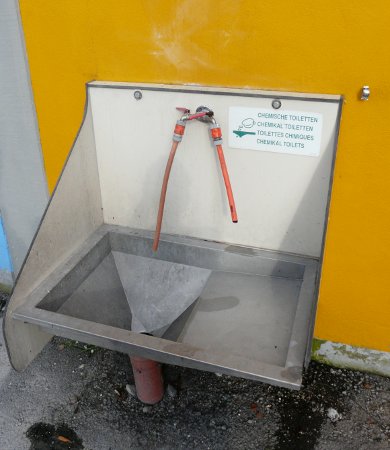
No crouching on the ground. No trying to hit a 3″ opening with a full cassette. No splashback. Rinse water right there. The whole thing flushes. Q.E.D.
They’re not tools of the devil, but cassette toilets are not as pleasant to use in North America, where we don’t have the facilities for them like they do in Europe.
Sorry James but I have to agree with Tom concerning the cassette toilet. We have had one for the last year in our van and have never had a problem dumping. Every toilet or Porta Jon is a likely dump station which cant be said for our Class C
I really love that compact class C! Thanks for showing it even though I could never afford it. Love how the bed was high giving you all that extra storage in the garage. You said the class A didn’t have air conditioning did the compact C have it? Also what about the controls? You never showed any. Did the Compact C have a black tank or was the toilet a cassette?
Hi Barbara! You touched on a bunch of things coming in our next video from the show…differences between European and North American RVs. One huge one is no air conditioners. Well, not NONE…they’re optional, but rare. James got a video of the rooftops of the sea of RVs at the show and there was NOT ONE AIR CONDITIONER!!! And they don’t have black tanks, only cassettes. As for controls, there was nothing spectacular there. European RVs tend to focus on looking good, not on technology or the unseen things. Even USB ports are minimal and hard to find!!! Stay tuned for our next vid…I think you’ll find it interesting! xoxo
Stefany Australian RV’s are in between European and American designs with many technical innovations( construction methods and materials , suspensions, electronics, air conditioning etc) As well types of RV’s that are unique too Australia