
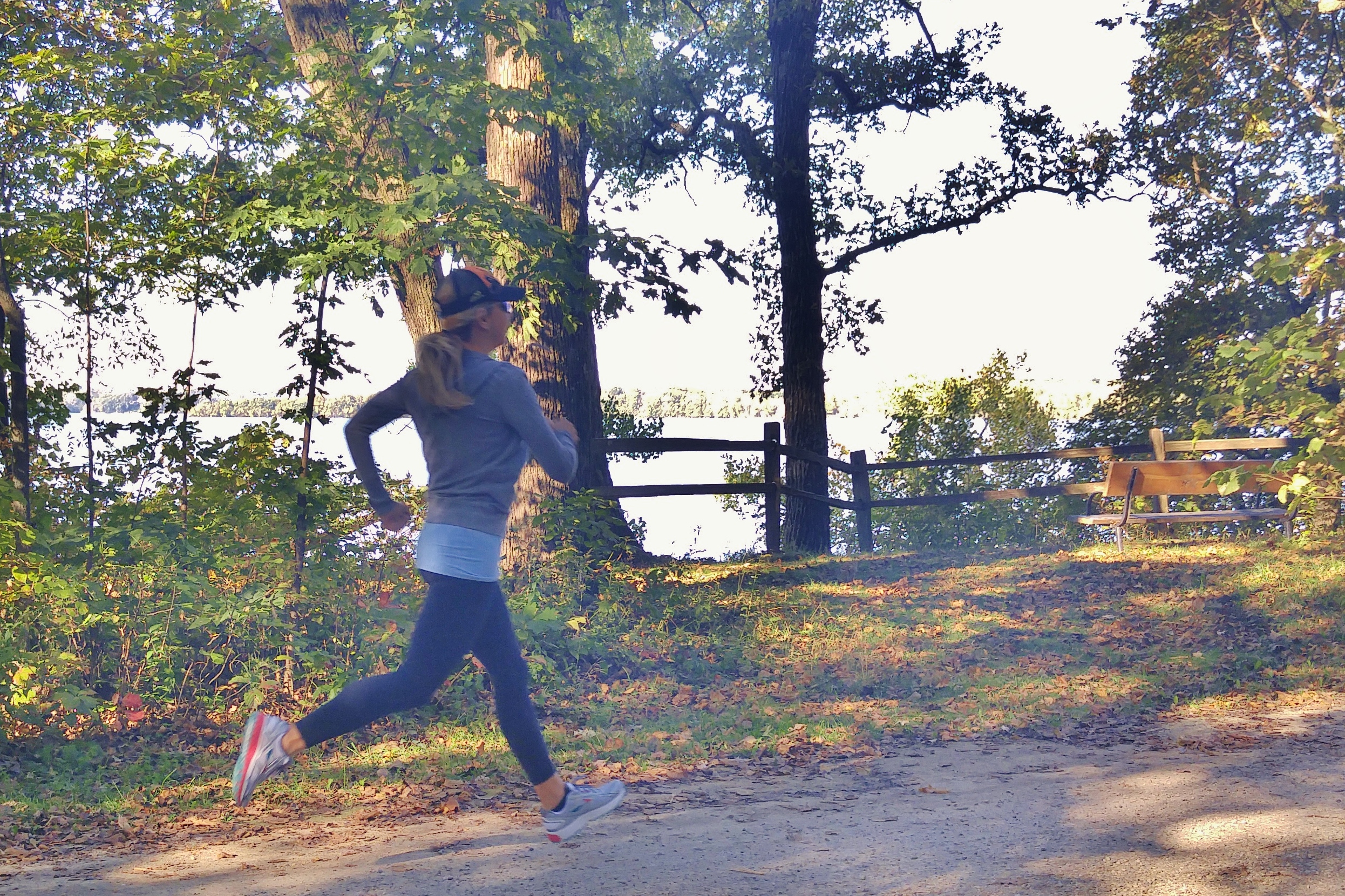
Since James is well into his 5k training program, and many of you are training along with him prepping for your upcoming 5k Turkey Trots (HEY, WAY TO GO!), it’s the perfect time to talk about good running form. On top of being a running expert, I’ve been a runner myself my entire adult life…so you can imagine I’ve got a little to say on this topic.

There isn’t one “right” way to run. We’re all built a little differently; each with our own natural running style preordained by genetics and body types. Although you never want to drastically tamper with what feels natural and right, there are some minor corrections you can make to stave off any overuse injuries.
Now, for those of you seasoned runners, if you aren’t experiencing any injuries, there’s no need for you to change a thing. But! If you do have aches and pains, read on…
Head and Neck:
Look straight ahead, not down at your feet. Keep your eyes about 10 – 20 feet ahead on the course, and try to keep your neck relaxed so that you aren’t holding extra tension. Tension in your neck can cause your shoulders to raise up and the head to tilt back too much, which could be a recipe for pain or injuries in the neck and shoulders.
Running Posture:
Try to run tall. Imagine you have a string attached to the top of your head pulling you up. You want your head up, your back straight, and your shoulders square. Avoid leaning forward or back from your waist, a common tendency when runners get fatigued. Get in the habit of doing a posture check every so often during your run. If you catch yourself slouching, use that imaginary string again to pull you back up.
The Arm Swing:
Your arms should be relaxed and bent at the elbow with about a 90-degree angle. The swing should come from the shoulder, not your elbow. It’s like a pendulum action coming from the shoulders. And be careful about allowing your arms to swing side-to-side. If your arms cross over the midline of your chest, you’re probably slouching and therefore not breathing efficiently.
Your Stride:
Don’t bounce! All that up-and-down movement wastes a lot of energy and is hard on joints. Try to stay low to the ground with your stride. The higher you lift your legs, the more shock you’ll have to absorb during landing, which will wear you out quickly. Keep your steps short and light.
The Footplant:
There’s a lot of controversy with how to land properly, whether beginners should use a heel-first landing or mid-foot landing. Some of this depends on your preordained running biomechanics, and therefore I don’t have a one size fits all answer for you. My best suggestion, keep your feet pointed straight ahead, and TRY for a mid-foot landing when you’re jogging, but if it just feels wrong, go back to the heel-first. The faster you go, try to get away from the heel-first landing, because they really don’t absorb shock as efficiently as a mid-foot landing. The tendency with fast running is to land on the lower ball of the foot, and this is what you want to aim for.
So, there you go, 5 suggestions you can work on to clean up your running form. Following these general guidelines should help get you running more efficiently and keep you injury free. And remember, newbies, you can follow along with our 5k Training Plans starting with Week 1 HERE.
Any questions or comments let me know down below!
xoxo, Trainer Stef








Hi Stefany!
I’ve been reading several of your articles lately and following y’all on Facebook. I’m 51 and started running about 3 years ago. Funny, before that time, I actually thought I was just one of those people who “couldn’t run”, as if that was a thing, ;). I’ve really begun to enjoy my runs, they aren’t long, mostly 1.5 to 2.5 miles at a time.
This article was great, and this morning when I ran I kept thinking about your tips to help with my form. I think it made my run feel even better today. 🙂 I don’t know that I’ve ever really though about mid-foot/heel placement before… very interesting!
Thanks for taking the time to share this info,
Kathy C.
I’m so glad to hear the article resonated for you Kathy! Thrilled to hear you picked up running and stuck with it, YESSS! For the most part, just trust your body and run however feels natural and comfortable… making slight adjustments as I explained in the article only if it feels right. Just as long as you’re running, then you’re already ahead of the game!!! xo
What would you recommend for shoe selection? Some are telling me the flatter the better.
Well, the flatter the better is SOMETIMES true. The idea behind it is that it gets you closest to your natural running gait, as if you were barefoot. But, depending on your form and build, that isn’t always best. I’d recommend you hit a specialized running store that gets good reviews, one that trains their sales team on how to analyze gait pattern and can provide advice on the best type of shoe for your personal needs. Best of luck!
Interesting tips, thanks. Nice to hear you suggest working with your natural running gate. My old track coach had a different opinion and made me run in such an unnatural way, I ended up with knee issues. So I concur, don’t try to make drastic changes. It can be more harmful than good!
You mentioned keeping stride short and that’s one thing I’m always working on. My tendency is to stride way too long which isn’t efficient. Here’s a tip that’s helped me. Spotify has a running genre that has music all set to match your gait. I used to run at 150 spms but now I’m up to 160 using the app. So the beat of the music becomes my coach!