
Well, at the risk of becoming known as “Professor Poo” on the internet, I’m going to continue…
The response to my first Black Tank Simulator experiment has been enthusiastic and the feedback plentiful. Thanks to everyone who took the time to sit through the video and provide suggestions. Some suggestions, like putting nail clippers through the tank, I probably won’t try. But I’ve spent the week gathering the feedback, thinking through changes I can make, and planning future experiments.
First – here are some of the suggestions that I’m going to incorporate right away.
Tank cover and venting
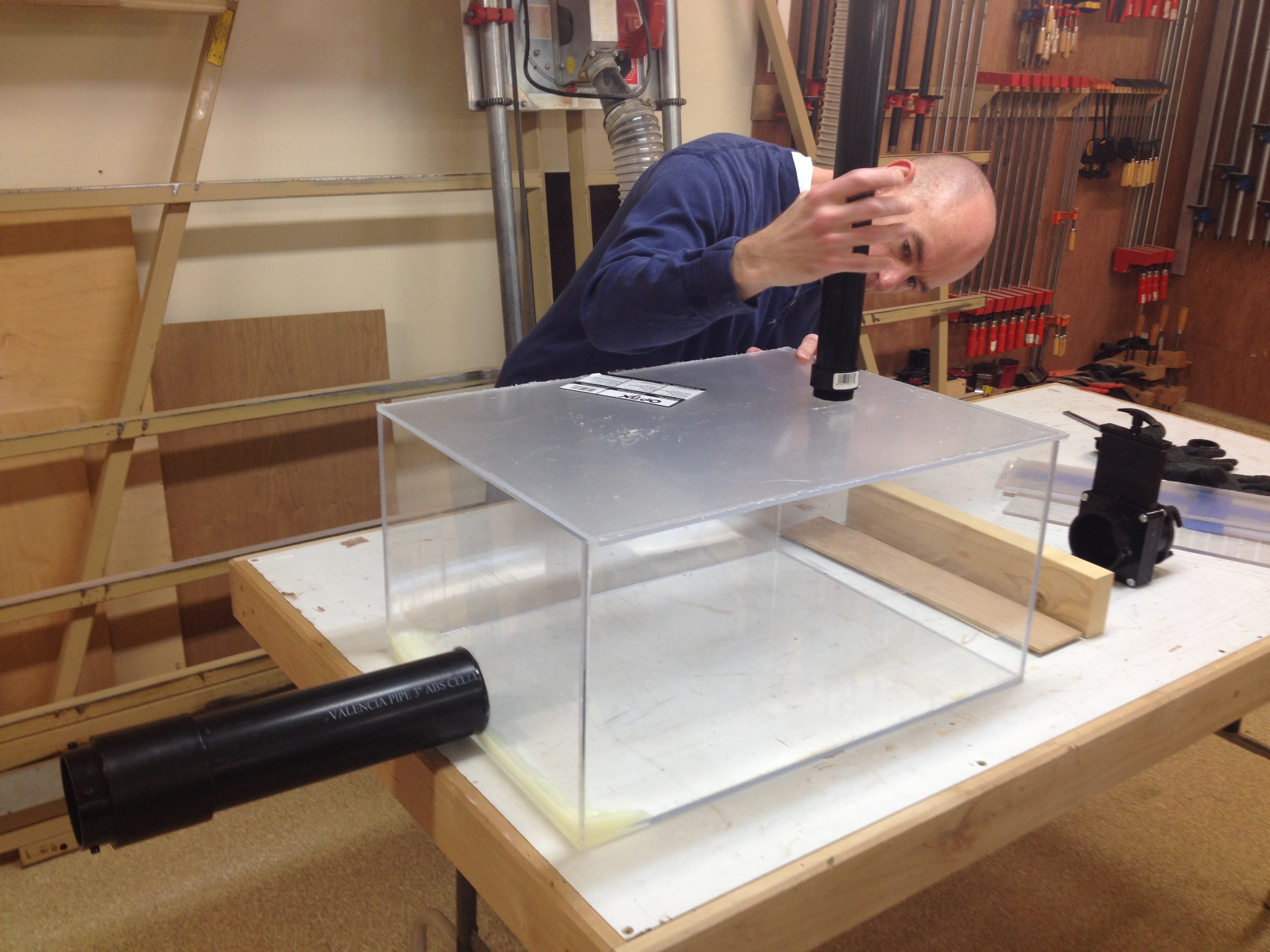
Real black tanks aren’t open at the top, although they should have a properly functioning vent. A few of you suggested that the reduced inflow of air from a vent stack would have affected the results. I don’t necessarily agree with that, but, since I obviously needed a cover anyway, I’ll be including a vented cover in all future runs. The vent stack in my own RV used 1½ inch ABS pipe, so that’s what I’ll be going with. The cover will be clear, of course, and removable so that we can easily see inside when the job is done. I’ve already started working on this, as you can see below.
Toilet Paper
My intention with the original toilet paper cut into strips was to hasten the decomposition to get the tank into a “used” state. But as many of you pointed out, toilet paper doesn’t go into the tank in uniform small strips. I’m sure we’ve all had to dump shortly after adding new material to the tank, so in future runs, I’ll be adding some wadded up, folded, and torn TP to the tank in addition to the strips.
Repeatability
Some of you asked questions like “what order was material added to the tank?”, “what was the temperature of the tank material?”, and “how long between filling and emptying?” While I tried to keep things consistent, these were questions I didn’t have the answers to. In an effort to make the tests more uniform, going forward, I’ll prepare and make available test sheets – which will list the steps and the observations.
Water Pressure
Many of you wondered about the very high water pressure I seem to have at the house. 120 psi is more than most can realistically expect, and quite reasonably, may have affected the results. I don’t want to hook my standard pressure regulator inline with the tank (even though it’s just simulated waste, and there are backflow preventers). But, in future experiments that call for fresh water, I’ll use a pressure regulator. I plan to buy one of the inexpensive regulators marketed for RVs, and use that one exclusively for future experiments.
Drain Plumbing
When I built the simulator, I realized I would never be able to make everyone happy. Each RV has a unique waste plumbing configuration of straight pipe, elbows, and wyes. Knowing this, I opted for the simplest configuration, and hoped everyone would be able to extrapolate the results for their rig. However, on testing, it’s rather obvious that a straight shot back into the tank creates perhaps unreasonably favorable conditions for a pipe-end flushing system. So, for future tests, I will be hooking up a pair of 45 degree elbows when I use a pipe-end flushing system. This will prevent the straight shot back into the tank, and, since I can buy the clear twist-lock ones, I won’t have to dismantle any part of the rig.
Now, on to what to do next. I’ve created an online poll right below where you can vote for what you’d like to see in future experiments. You can vote for more than one option that interests you. I can’t promise that I’ll tackle them in order of popularity, but this may keep me from spending time and resources on something that isn’t of interest to anyone. Brief descriptions of the experiments are just below the poll
Comparing the effectiveness of tank additives:
For this experiment, I propose to test three different tank additives (and no additive at all): A standard, toxic “blue stuff” additive; an enzymatic additive; and the oft-mentioned GEO method. I would add the simulated waste incrementally over three days to give the additive opportunity to work. I would not agitate the contents of the tank prior to dumping. Each test would conclude on the fourth day with dumping from a standard 3 inch hose. I would need to find a way to store the partially full tank for several days in controlled conditions – and then a way to move it over to my sewer cleanout – to make this possible. Due to the nature of the test, it would take a couple weeks to run.
Testing the dumping action of a macerator:
In most respects, this would be similar to the last test of the Sewer Solution. I would test a macerator pump and compare it to the standard 3” hose. As neither a macerator nor a 3” hose come with a tank flush as standard, one would not be used. The expense of the macerator would be one downside, unless I could obtain a manufacturer sample. This would also require pulling a 12v battery with adequate capacity from somewhere to power the macerator.
Testing the conventional wisdom:
For this test, I would propose four runs to test the effect that tank fill level has on emptying solids from the tank. This would require filling the tank ¼, ½, ¾, and full – with proportional amounts of solids – and then dumping through a standard 3 inch hose.
Testing various tank flushers:
The intent of this test would be to compare several tank flushing methods for their effectiveness at removing remaining solids from an emptied tank. I propose to test three flushing methods: the RV Hydro Flush pipe-end flusher, the Sewer Solution, and the Tornado tank flush system. For this test, I would utilize the clear elbows and regulate water pressure as previously mentioned. I realize that there are several flush protocols I could test, but to keep things consistent, I would select a single flush procedure (e.g. flush continuously for 5 minutes, then dump all remainder) to test.
In depth with the Sewer Solution:
Finally, I’ve received a number of comments and questions on the Sewer Solution. I could go more in-depth with this particular tool and test things like: how much fresh water is used at various pressures, the effectiveness of various flush/dump/flush protocols, maximum effective vertical pumping of sewage, etc. I would need to solicit tips from experienced Sewer Solution users to make this a more effective segment.
Well, there you have it. Those are the experiments I am considering running next. Think about it, and vote for those that you would like to see. I will leave the poll open for a few weeks to give everyone a chance to weigh in. In the meantime, I’ll finish up making my lid and vent stack. I also hope to do some actual RVing too!







Most newer model black tanks have the tornado style black tank flush. I typically start my tank flush as soon as I start to dump my tank, then leave the flush running and repeatedly close the termination valve for a couple of minutes, then open to empty to help clean out the remaining solids that may not have flowed out with the initial flush. As a result, my sensors seem to work consistently…..a complaint that many RVers have.
Love the work you two have done. Fun, excellent.
I am brand new so you will have to excuse me here, but what about oxiclean. I am a brewer and that is what we use to clean stuff. Its amazing. Perhaps 1 tbl per 5 gallons a very weak solution. Let it sit overnight and drain. Maybe rinse. I feel certain it would spit shine a black tank that was caked with dried waste on a day or two. Thoughts? Thx.
Can’t hurt to try it.
Not having messed with an RV black water tank, I was wondering if they are square like your video or rounded at the bottom?
Most of them have a radius of some sort at the bottom. I added generous heaps of silicone at the bottom seams to model this.
I would love to see a video about tank additives. How effective are enzymes? How long do they take to work? Please include a test where you just add some liquid dish soap too. That might be good enough to keep the sides of the tank from getting as greasy.
Yes me too!! Has this been done yet???
We got a new rig with a composting toilet. So all of the black tank experiments became less pressing for us.
I think because of your ability to use two clear waste tanks, you are the best person to demonstrate Pascal’s Principle, (water seeks it’s own level).
I’ve used it several times to use gray tanks to flush black tank (saving fresh water), and can also unplug toilet paper clogs. Must have a blade valve after where black and gray pipes meet.
Feel free to contact me for more info. Thanks.
I have been using the tank additives as well and wonder if they really help. I read somewhere to use Dishwasher soap in 5 gallons of water while traveling, I dump at home and use the tank wash hose.
A thought if you will.Dump the tank with the 3 inch line first then use the back flush to clean tank. just a thought
Thanks for the vieos. Im a newbie at RVing & your tests and explainations are very helpful (especially after the bad info Ive been told)
If you are going to test black tank cleaners, please test “the blaster” sold at Walmart. I use it every empty & it seems to be working but your test tank tells the truth.
James — I don’t know if others have mentioned this but could you install tank sensors into your clear black tank and show people how bits of paper and such can foul the sensors and give false readings? So many people seem to really struggle with keeping their sensors clean.
Thanks!
Mitch
I thought about that, but we’re not going to go there. Here’s why:
Installing through-bolt tank sensors in an RV would be like installing a telegraph in your kitchen. It’s incredibly backwards. Much better solutions exist now.
We’d rather show people new and better ways to do things (sonar tank sensors, compressor fridges, etc.) than work with extending the life of something that really should be left to die (absorption fridges, frankensteini-bolt tank sensors, etc.)
Below you say you got a composting toilet so it was less of a “pressing” issue. The way you said that, plus the need to do videos, I am going to get a poo bucket and bags. And only go number 1 for now in rv.
As a final poo thought, what about poo pouri. I home make it and it works! Its only alcohol, essential oil, and glycerin, I bet it would make your compost toilet smell nice. Pre spray bowl.
It might make a nice deodorant type thing. But within a composting toilet, there’s a fan always drawing air to the outside. The smell isn’t as much of an issue as you might think. If you smell it, it usually means something is wrong.
With 20 years in the RV repair biz, I’m the one who gets the call when black tanks won’t empty…my least favorite job ! Your tank simulator and tests are fantastic. I have a lot of customers who never take their rig on the road, so tank management is vital. For these people, I recommend; 1.After dumping, fill to floor level, let soak for 12 or more hours if possible then dump. 2.Use a clear hose adaptor to monitor rinse effectiveness & repeat if necessary. 3.Do this at least once every 4 dumps. 4.Dont trust built-in tank rinsers, since many are ineffective. I subbed to your YouTube channel…good stuff !
Sewer solution wouldn’t work for me because I don’t have a straight shot. I bought it used and suspect it has major build up. What should i do, sensor reads 3/4 full even after flushing
When people ask me this question, I’ve been recommending a product called NoFlex Digestor.
The guy that runs the company is very responsive, and he’s provided great support to people I’ve sent his way.
Everyone I’ve pointed in this direction has let me know that they are satisfied with the outcome.
Best of luck!
Hi, I like your videos, very informative.
I have a problem with the black tank in a camper I purchased used.
There appears to be a lot of dried up tissue and/or po in the black tank.
If I fill the tank with water, I get good flow until the water gets down to a certain level. Then is slows down and trickles for quite awhile until it finally stops.
Someone sugested a tissue digestor. Let set for a couple of days and try to flush it again. I have not tried it yet.
Do you have a recommended procedure for taking care of this problem?
Thanks,
Bill
Hi Bill – Glad you like the videos!
Can you actually *see* something down in the tank? Here’s the reason I ask: Even on the clear black tank – which we can clearly see has nothing in it – we get the same kind of flow you describe. Liquid rushes out initially, and then slows to a trickle for several minutes before it finally stops. That’s sort of just how it flows, and I was surprised by the minutes-long trickle initially. You may be OK.
But if you have other evidence that there’s something stuck down there, there are a couple things you can try:
1. I have not used it myself, but someone else recommended a product called No Flex Digestor. It’s something from the marine world, but I’ve heard stories of it working well in situations like this.
2. The second thing to try is the old “wand on the hose” down through the toilet to try to break things up with water pressure.
Those two things, in that order, are probably what I would do next.
If those don’t work, you may want to try a professional cleaning. (There are services out there, but I’ve never used one. They claim to work well.)
Thanks for reading!
James,
The trickle is several hours rather than minutes. I would say 2 gals of trickle. I guess the only way to find out if there is crap in there, is to rent a scope from somewhere (home depot) an see what is in there. Although I am not sure what to look for. I will look into “No Flex Digestor”. I have some tissue digestor from Thetford. I tried to find a professional in the area but could not find one. I can take it to the dealer repair shop. They said they could work on it.
My black tank has a hose attachment to fill the tank. Would that have the same affect as using a wand?
I was thinking you may have already simulated a similar situation in your
test tank.
Bill
If your black tank has a hose to fill it – I’m guessing that’s some kind of black tank flush?
You could try leaving the black tank valve open and connected to sewer, and run that black tank flush for a while and see what happens. If you’re worried about some kind of clog, be sure to have someone inside to watch the monitor to make sure you’re not filling the tank up behind some sort of jam.
That’s not exactly the same as using a wand, but it might help.
I’ve not tested a jam, exactly. I did try to bake some stuff on and use ice cubes once. But it was nothing that clogged the outlet.
James
If you have built the testing tank and would like to try the Noflex I’ll send you a bottle.
We developed it for the heavy marine market and have moved into light marine people are now trying it for RV and septic all with good results sort of a spill over, what works on their boat works on their other systems.
Dave –
We’d be thrilled to give it a try! I need to get back in gear with the tank tests, and this may just be the motivation I need.
I’ll take this to email and we’ll work it out.
James and Dave,
I bought a bottle of Noflex Digestor. Now how to use it my
situation. The instructions on the bottle are for minor problems
and suggest 1/4 ounce per person per every 2 days of use.
In my case I have a build up about an inch thick on the bottom
of a 40 gallon RV tank with dried up poo.
I was thinking of adding some of the Noflex Digestor to a gallon
of water. Shake it up well and dump it down the toilet. Then add
another 4 gallons of water and let it set for a couple of days.
Then add more water to the tank to get it about 1/2 full and
then dump it and see the results.
The question is how much of the Diestor for 5 gals of water to
get the dried up poo loosed up so it will flow out of the tank
drain.
Any suggestions.
Bill
I don’t know how often Dave is checking this page.
I’ll take this to email.
OK everyone!
Just to close the loop on this, we did hear back from Dave, with NoFlex Digestor. Here’s what he had to say about tackling Bill’s problem:
“Basically correct in how to use in what was said
You can make it simpler
Put in a ¼ of a bottle and fill the tank ½ of water with a hose Or a couple of buckets dumped in fast so it moves the Noflex around as much as possible.
Let the tank sit for 24 hours then fill with water and let it sit for 2 hours and then dump
When you get it clean just use ¼ once every day doesn’t matter as long as you have no more than 6 people”
I had severe problems draining my black tank. The drain flow was about half what I would expect it to be. After most of the water came out, it took several hours of trickle to empty the tank.
I purchased a 16.8 oz bottle of NoFlex Digestor. I mixed 4 oz of NoFlex with 20 gals of water and let it set for 48hrs hours. When I drained the tank, the flow was what I thought it should be and the trickle was only a few minutes long.
It worked great. None of the other treatments I tried previously, had little or no effect on the build-up and drain blockage.
Bill
I just discovered your videos and your website while looking for information on how to service my rooftop A/C. You are brilliant. There is so much crap information out there. You show the proof of what works and what doesn’t work. I am changing my toilet paper from now on. I am really interested in the test of various chemicals since I have been having an odor problem. Our RV never moves. It is permanent in a retirement community so I am looking for a good cleaning method. Keep up the great work.
RetiredSKP
Glad you like the site! We started using the Charmin Ultra Soft after we made that video too. I’ve been meaning to get to the additive tests for a while, but I got myself bogged down with a woodworking project over the winter. I should be finishing that up in the next month or so, and can start with the tank additives. I’ve had all the supplies I need for a while – just need the time and space to complete the tests.
Thanks for visiting!
Hello hello!!!!
I love the videos….and all the info!! My Wife and I are full time RV’s we live as park host for a county park….Any way the subject of black water and the holding tank is a weekly thing at our place!
Here is our process. We leave the grey water open all time, and keep the black water closed till its time to flush. Here is where it gets interesting! I constructed a long 1″pvc pipe capped off at one end with a standard hose connector at the other. I drilled about 10 holes near the capped end, they are arranged vertically spaced about 3/4″ apart on the pvc. when I connect the hose and turn on the water, the water jets out of those holes, so I go on top of the RV and feed the 10ft pvc through the vent pipe, I turn on the water and rotate the pipe back and forth, we close the valve, clean and dump…three times
Jose! Just when I thought I had heard it all… Very creative! I like the idea of the homemade in-the-tank flush, but had never thought of going up onto the roof to get it done. Your system would get you similar results to a tank rinsing wand, but without having to carry a dripping, poop-soaked baton and hose through the living space in your RV. (Stef would never approve of one of those wands, and that’s why I’ve never tested one.) I award you bonus points for originality!!
Hahaha!!! Thank you Sir!
I have to admit! I almost purchased one of those Bore scope inspection tools with the LCD screen to look down in there….but I would not be able to bring myself to put it in the toilet!! Ew….
So I went with the pvc idea, I was very curious to know what my tank looked like, but now after watching your videos I know! I use those purple pills, those holding tank deodorizer a….it’s says they break down waste and paper…..anyway! Thanks for the reply and the videos!!!
you could lower the export output on the tank down a little more then the rest of the tank so it look kinda like this _____________________
I tank I
I I
I ___________________I
I I
___ I I
to sewer ______I
Kevin – I can’t quite make out the ASCII art, but I did add a couple 45 degree elbows in the next experiment. It drops the output a couple inches, and prevents the straight shot back into the tank. You can see it at the beginning of the video for the next experiment, here. Is that what you had in mind?
Perhaps you could add a black tank flush connection to your simulator. I use the black tank flush every time we dump and as far as I can tell, it keeps the tank reasonably clean. We don’t have the residual odors that our last RV had without the black flush connection.
It’s on the list! Stay tuned.
How about testing the SWAN SAN-T-FLUSH which is used on many RV’s, and on the Leisure Travel Unity that you reviewed in some detail?
That’s not a bad idea. Is it similar to the Tornado? I’ve never seen one for sale locally.
James it looks like you already have most of the bases covered. I have a class A Winnebago Tour that has a built in flushing system in the black tank. It would be great to know if these systems work well or if I should consider an external additional system. I really enjoyed the video and appreciate the effort you put into it to help us all do a better or at least more informed job of flushing!
Thanks Tom. We’ve been out on the road for a couple weeks, but we’re back now and I should be firing up the simulator again pretty soon. Stay tuned!
Thank you for doing this test and posting your results. The black tank in our 5th wheel is around 40 G. It has a slope, with the shallow end directly under the throne. It came with a built-in tank flush and we have had success using the Flush King. Takes time, water and a “private” sewer connection.
After 3 yrs of fighting faulty readings from the internal sensors, I installed external “See Level” sensors that give much more accurate readings. One advantage to these is I have a secondary panel in the utility bay, so I can check tank levels without going back inside while flushing.
Have tried various types of tank additives, though none seem wonderful. There are tons of variables, so you have a veritable lifetime of testing ahead.
As they say, thanks for sharing!
Glad you liked the video. I think you’re right – I’ve received enough suggestions that could keep me testing for months!
We also added the SeeLevel system to our RV, and I’ve never looked back. It was one of my first mods.
Hi James,
There are an almost infinite number of possibilities to test, so I suggest, and as you have done, try and keep it simple and straightforward.
1) I suggest that any flush system’s 1st job is to add water to float what can be floated and through impingement and flow, move what can be moved. The second task may be to spray sidewalls and sensor probes. This second task seems to have a lot more variables and so difficult to quantify.
2) With any chemical or enzymatic action, concentration, actual contents, physical consistency, pH and temperature are all going to be important. I suggest you pick what you can measure easily and control & keep constant what you can.
Keep up the great work!
Tom
James or Professor S@#t (With Respect),
I think your testing is long over due and the way in which you are approaching the various dumping methods is very enlightening and well thought out.
I keep my dumping simple and use the 3″ flexible sewer pipe. But I think a secondary rinse is important. Being a solo camper, for me, it is not practical to go inside as you’re dumping to put a fixed or flexible wand into the toilet.
I’m strongly leaning towards the permanently installed Tornado with the auxiliary hose and would be curious as to the effectiveness of either going in straight or using the wedge and aiming at the bottom at an angle and at what height.
I’m sure you will do it anyways, but timing the secondary flush would be of interest. If you’re at your camp site, you can take all the time you want. But, when you have people waiting behind you, how long is efficient and how long is too short and ineffective.
Thanks. Looking forward to your next report. Keep up the great testing.
John
Actually, all five tests would be great… but…
I chose the macerator, as I’ve never seen one working —
And the tank flushers, to see how good the actually work. With Barney, if you could add one of those inexpensive “wand” flushers that would be great.
Thanks for doing all this!
You’re welcome! I do need to start working on getting a macerator. Hopefully, I can get a sample, because I don’t want to shell out the $$ for something I may test and decide never to use.
(I don’t think you can return them. Because… you know… ick.)
James,
I think if you contact he manufacturer and tell them what you’re doing and direct them to your blog, you’ll get samples if they are serious about their product and effectiveness or just a fancy gimmick.
That’s just what I did with Valterra for the Sewer Solution! They were very willing to be part of the test, and I very much appreciated it. I intend to try the same approach with FloJet and Thetford (Sani Con). Hopefully, one of them will come through (because those things are expensive!). If that doesn’t work out, there are a couple other angles I could try. I’d rather get it straight from the manufacturer if I can though.
You can get a Flojet 18555 macerator for about 150 delivered after some careful shopping. This is probably the most common/popular macerator out there, as it DOES have a rinse feature built into the head. If you’re close to central NY, I’d loan you mine or maybe you can find someone to loan you theirs closer to you.
I vote for testing various tank flushers. When you test the hydro flush, make sure you use one that has a dump valve on it you can close, so that you can force water back up into the tank like a Flush King or Sewer solution does. Otherwise, it is not very useful.
Good point, Will. If the hydro flush I wind up with doesn’t have a valve, I can rearrange the valve I’m using now to put it after the hydro flush. They’re all twist-lock pieces, so it should work out.
I would propose that you also test a “through the toilet” spray wand in addition to the three you mentioned. I have a “Flush King” pipe end device, a built in tank spray flusher (not Tornado), and a simple through the toilet wand, which is a PVC pipe with holes in one end and a shut off valve on the other.
I prefer the though the toilet wand over all the others as it does the best job. The “Flush King” is almost useless for the black tank and I use it only for the kitchen and bathroom gray tanks. It could come in handy if you had something stuck in the outlet of the black tank though.
The built in tank rinser works ok but doesn’t seem to get all the “stuff” out like the wand does.
Barney
Oh my! I’m laughing thinking about how the Black Tank Simulator would look with a toilet perched on top. Lol!