
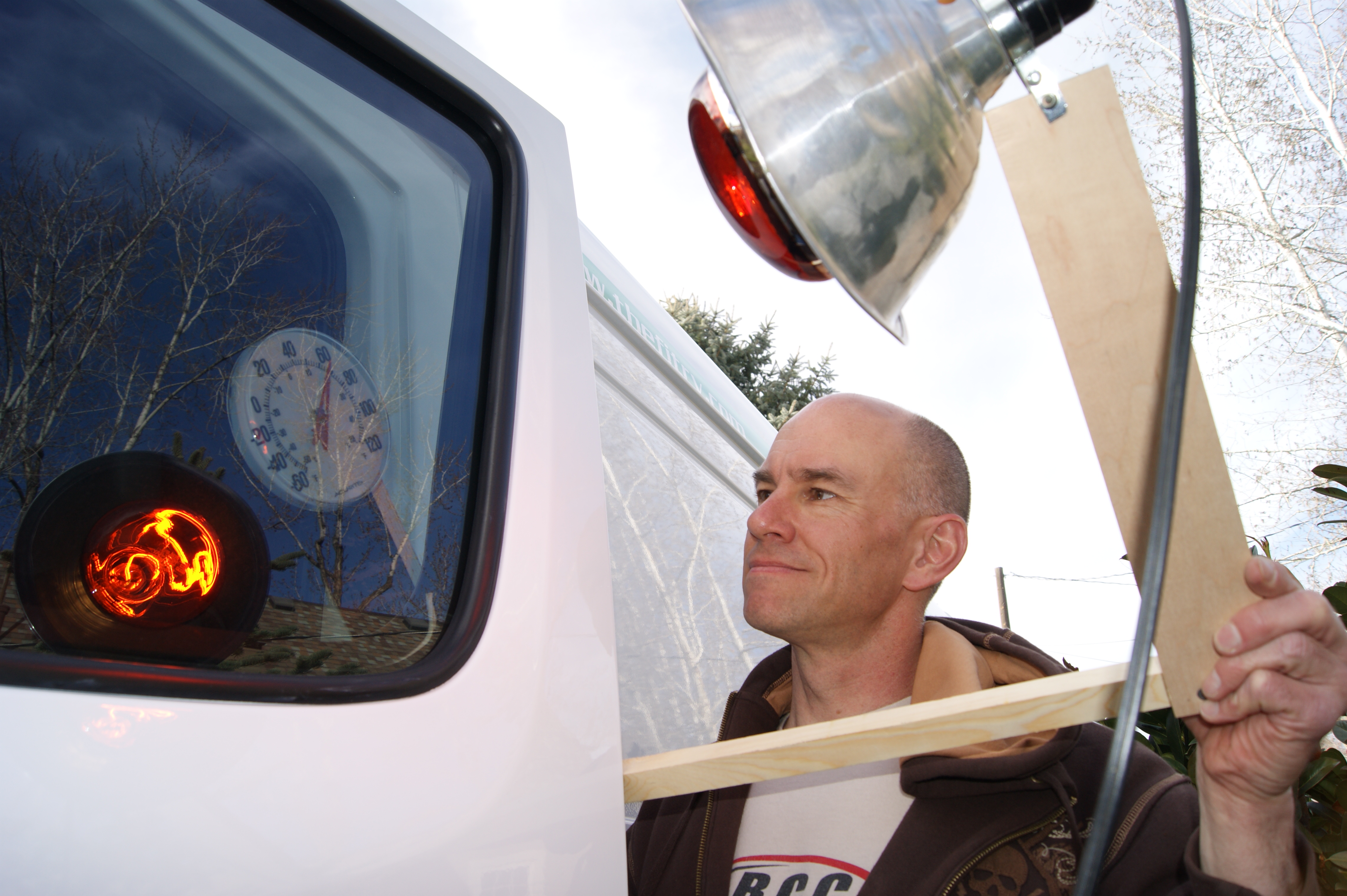
Driving for long stretches out west, we’ll often have the sun scorching us through one side or the other for hours at a time. In the past, we’ve tried several dubious, and likely illegal, things to escape the baking. Things like shoving towels in the windows, baby shades, and sitting nearly sideways with the cruise control on. Yes, we’ve been that desperate to escape the heat.
You’ll remember that one of the finishing touches we put on Das Bus was the addition of some 3M Crystalline Window Film onto the front side windows. This film is touted to reject up to 60% of the heat coming through the windows. It almost sounds too good to be true, but judging from the prices they charge for the film, someone must believe in it. We were just desperate enough to pay to have this rather expensive film installed on our side windows. The two side windows in our Sprinter (4 panels) set us back about $300.
But does it work? Or are we just victims of the Minnesota Marketing Machine? (3M, get it? Ha!) Would some other kind of window film work just as well? That’s what I wanted to try and find out, in a semi-objective kind of way. So I unleashed my inner nerd and set up some tests. Here’s what I did.
The test setup
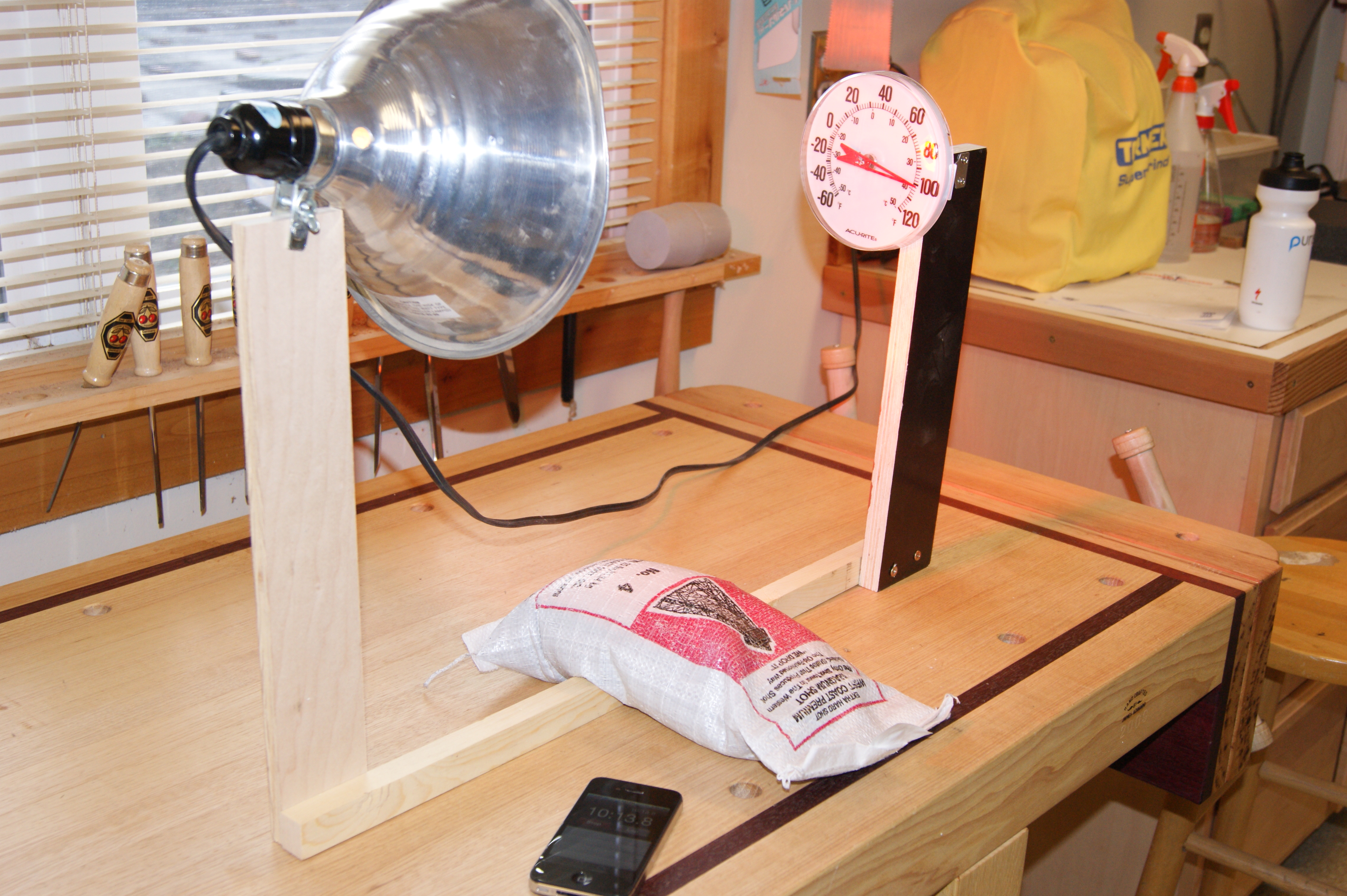
Here’s a photo of my test rig. It’s not too fancy. The heat source is a 250 watt heat lamp. For window tint, we’re only really worried about radiant heat – not convective or conductive – so this should be sufficient. To measure temperature changes, I used a cheap outdoor thermometer. I wanted to keep the heat lamp a consistent distance from the thermometer, so I built this simple jig. Basically, it holds the lamp 12.5 inches away from, and on-axis with, the thermometer. I also used a second, equally cheap, bulb thermometer to measure any changes in ambient temperature during my test runs. Fortunately, the dial and bulb thermometers gave the same readings when left to settle. Finally, I used my phone as a stopwatch.
Bench testing the rig
I wanted to get a feel for how much the infrared lamp would change the temperature with no glass involved; and I also wanted to make sure that the setup gave reasonable and repeatable results. So to test the rig, I completed two runs just sitting on my bench. The procedure was basically:
- Record the Starting Temperature
- Turn on the lamp
- Wait 10 minutes
- Record any temperature change
- Record any ambient temperature change and use this to get a corrected temperature rise (ΔT)
I then waited for the temperature to drop back to the ambient temperature, and repeated the test. The two runs gave corrected temperature changes (ΔT) of 36 and 38 degrees for a 10 minute exposure. The two runs agreed within two degrees, which I judged to be within the margin of error for such cheap equipment, so it was on to the next test. I followed those same steps for all of the test runs that followed.
Testing clear glass
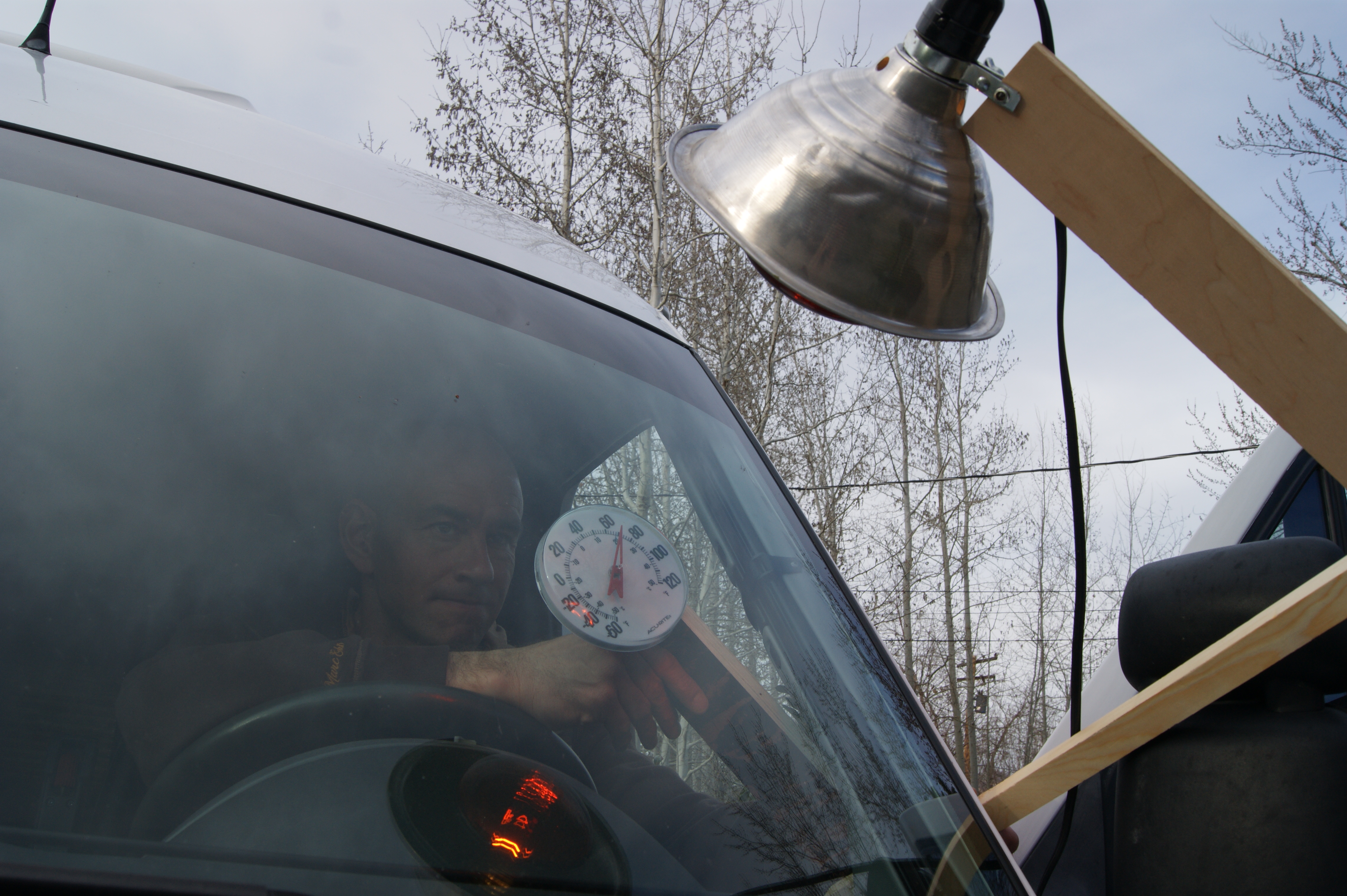
I really wanted to test the untreated windshield in the Sprinter. Unfortunately, I had some difficulties getting this to work. First, there was not really a good place to get the RV completely into the shade to eliminate sunlight. And second, the curvature of the windshield made it difficult to keep things lined up. As you can see, I was just holding the rig. Testing in this way with the curved windshield wound up deflecting much of the light. As it was, this test gave me a corrected ΔT of only 13°. This didn’t correlate at all with my real-world experience with this windshield, so I decided to throw these results out, and test again with some clear plate glass I had in the shop.
This gave more realistic values. In fact, it gave corrected values that were about the same as not using any glass at all. Now granted, this was not the same as using an automotive windshield, but it was the best I could do. To the best of my knowledge, our 2003 Sprinter does not contain the new IR-filtering glass required as of this year in California.
Testing standard window tint
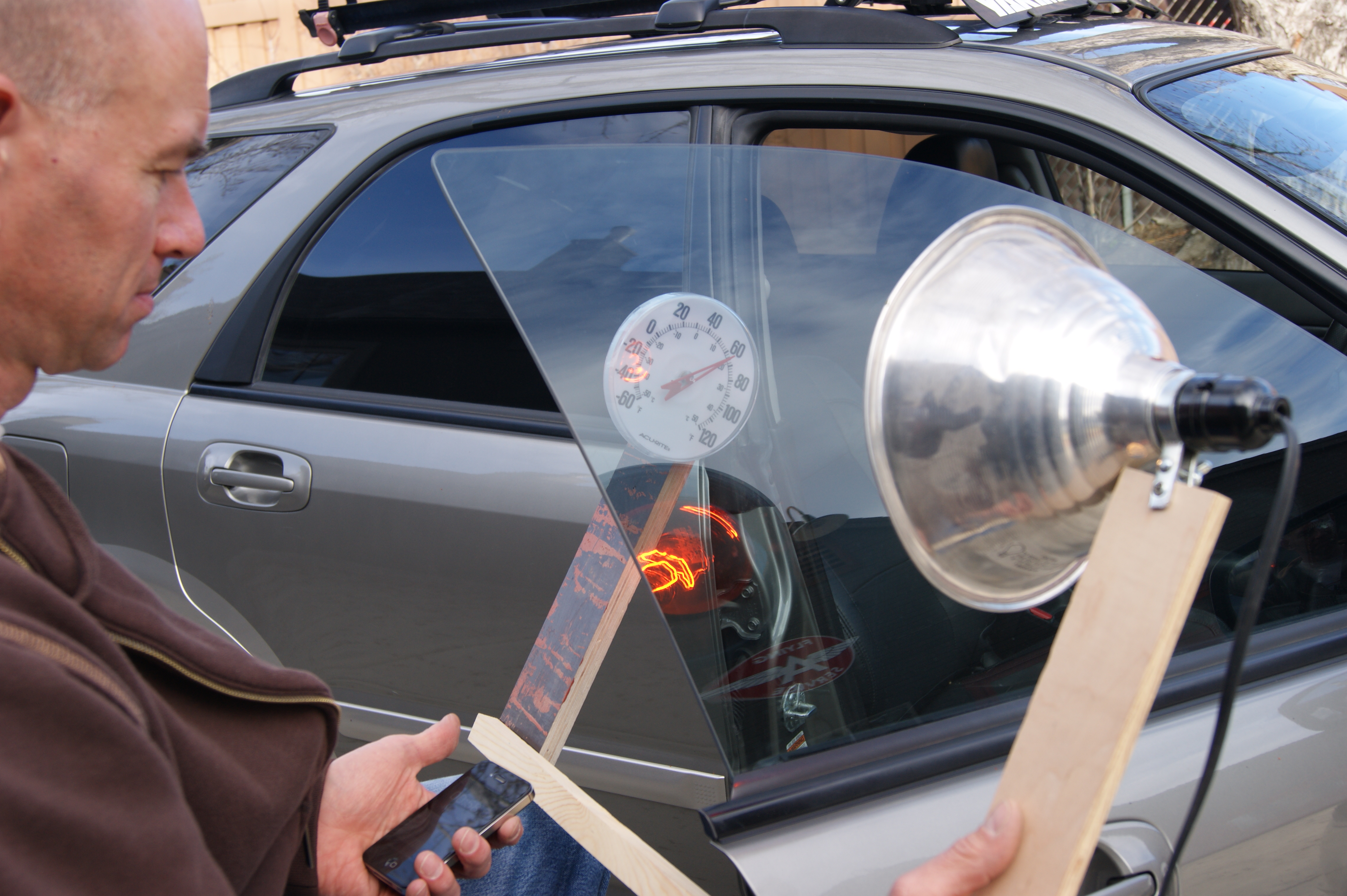
I have a “regular” window film on the windows of my daily driver. It’s actually a 3M film, but not the Crystalline. On the front window that I tested, it’s also a legal shade for driving here in Utah – the same shade that we had installed in the RV. I decided to test that one next. Here I am testing the window film on the front windows. I ran the tests outside, so the corrected temperature readings became more important. Also, I should note that I did this on a calm day – no wind. This test gave a corrected ΔT of 20°.
Testing another tinted window
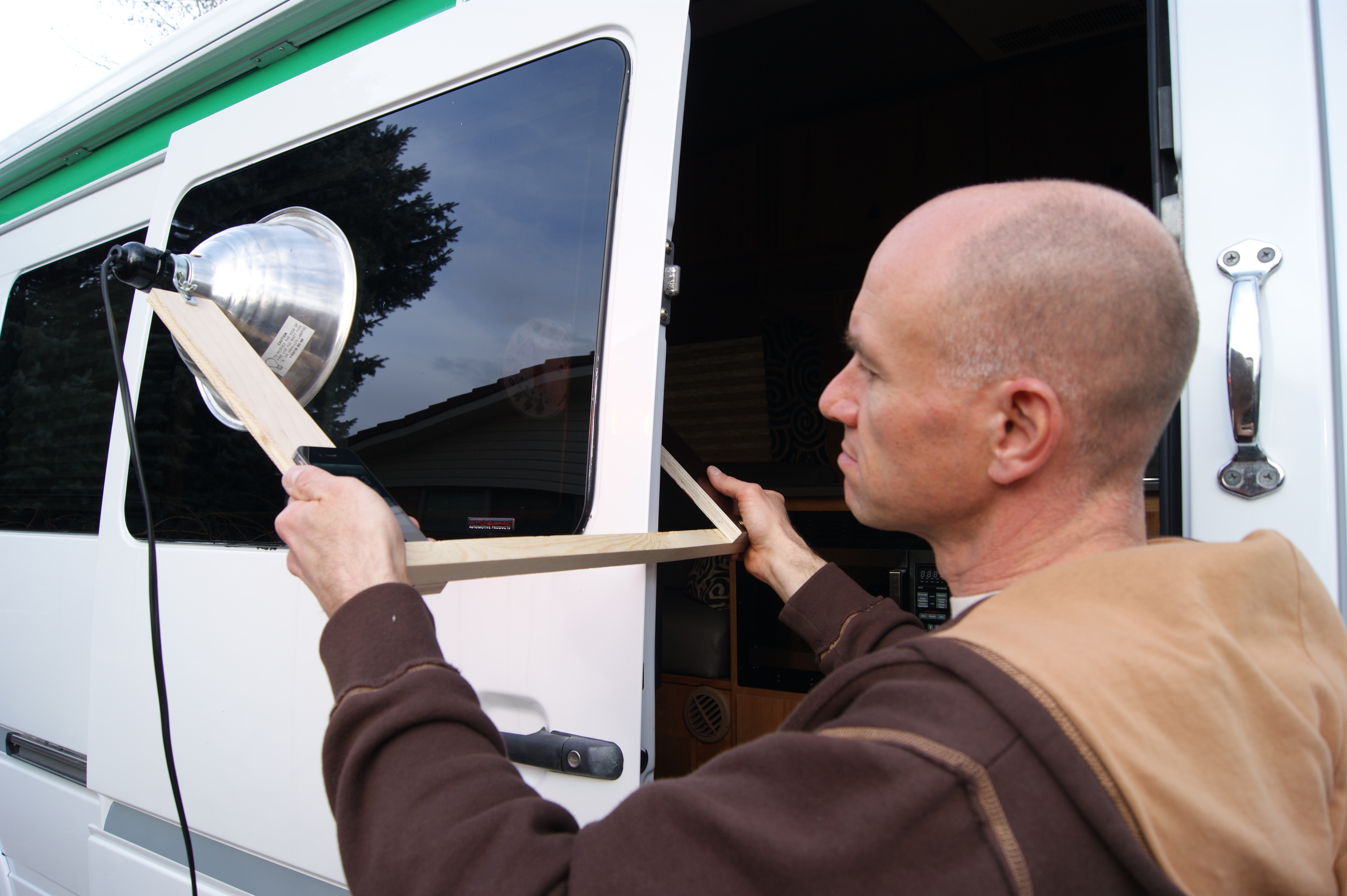
The windows in the living area of our RV are CR Laurence Automotive windows. They come tinted, and there is no need to apply any kind of film to these. I decided to test one of these, and here’s the photo of that.
These windows tested out better than the standard window film on my Subaru, and after 10 minutes, gave a corrected ΔT of 17°.
Testing the 3M Crystalline Window Film
Finally, it was time to test the window film that was supposed to perform the best. These were large, flat panels, so I didn’t have any trouble getting things lined up.
After 10 minutes, the test gave a corrected ΔT of 12 degrees. This was the best result of the bunch. The temperature gain was 40% less than the standard window tint on my Subaru, and 30% less than the CR Laurence tinted windows, and a whopping 68% less than the untreated glass.
Here is a summary of the results for all test runs:
[table id=3 /]
But how does it feel?
Numbers in a table are one thing. But it doesn’t matter what my chart says if I’m still uncomfortable in the sun. So subjectively, how did I like it?
Well, on our recent trip to Moab, the weather was great and the sun was out. I made sure to take note as the sun alternated between the windshield and the driver’s side. Now granted, this wasn’t the worst of the summer sun, but it was enough to give me a taste of what’s to come. I can tell you that the sun through the windows with the 3M film was definitely less oppressive than when it came through the un-tinted windshield. The film certainly helped, and the sun felt “muted” through the 3m crystalline film. I could absolutely still tell the sun was there – I could still feel it, but I wasn’t reaching for a towel to shove in the window either.
So would I buy it again?
That depends on what you’ve got to start with, and how much driving you do. If you’re heading west for 14 hours across the Nevada desert in July, you might feel differently about window tint than someone who plans to drive due north for 2 hours in the forests of upstate New York. So consider your own needs when you think about window tint. But if you want my opinion, here’s what I’d do:
- If your windows already have tint on them, don’t rip it off and apply 3M Crystalline film.
- If your windows are already tinted (without any film), it’s also probably not warranted to apply the expensive 3M Crystalline.
- If you have un-tinted windows, then consider this film. But it’s expensive, so apply it where it makes the most sense. In our RV, that meant the driver and passenger side windows, where we needed the best performance with the least amount of tint (to keep things legal).
- If I had a big Class A motorhome, with the gigantic side windows up front, I would apply this film. That’s a lot of glass, and a lot of heat. I’d do everything I could to mitigate it.
- In a car, you can typically tint the rear windows very dark. So for a passenger car, I would go with a cheaper, darker film elsewhere, and save the 3M Crystalline film for the side windows up front, where you’re forced to use a lighter tint.
So there you have it. Hope you found this helpful. If you have any questions, let me know in the comments below and I’ll try to get back to you.







I live in Bay area, CA. We are not allowed to tint windshield in CA except for a small 6″ strip on top of windshield. Side windows in cab can only be a very light tint. Reading these comments it looks like you CAN use 3M Crystalline tint on entire windshield and side cab windows. Is this correct? If correct, why? Is it because its not a ‘window tint’ but a UV remover for skin cancer? Someone please clarify this.
I cannot afford the 3M. I am looking for a cheaper alternative I can install myself. Does anyone have any suggestions on good window film for house section of RV and another one for windshield and cab windows? I can buy this on Amazon. That would be ideal. So hot in both my tiny Yaris and Class C RV. Please help!
I don’t live in California, so I can’t say for sure. But I do know there is a virtually clear Crystalline tint that you can put on a windshield. It makes a huge difference.
I don’t have any recommendations on a DIY tint for you. Ever since I tried the crystalline, I’ve never looked back.
Thanks for sharing this valuable info! Is there any change in optical clarity vs the factory glass? I’d like to put this on the windshield of my Pleasure Way. Do you figure it could also be an excellent help in insulating the glass when heating during the winter heating months? And perhaps reduce fogging and condensation because it should reflect the furnace heat back into the interior.
It’s been a few years since I did this, but my opinion about Crystalline window films has not changed.
I actually put the Crystalline clear film on the windshield of my pickup truck. I haven’t regretted it at all, and I don’t notice anything other than it’s less hot in the truck.
I don’t think it would help much as far as insulating in the winter. It helps with radiant heat, but the heat in your truck is primarily convective. I wouldn’t consider any winter insulative benefits in my personal calculations.
Hi James; we have a 2020.5 T now & live is S. FL. I’d like to get the Crystalline on the front windows & windshield based on what I read here. I assume there is no factory tint in either so there should be no need to remove anything before putting the Crystalline on. Is that correct? Also any suggestions on where to get it done in SW Florida?
Correct – there is no factory tint (at least, not in film form), so nothing to remove.
No idea on a south Florida tint shop. 3M may be able to help you with a list of authorized resellers?
What would you expect from RV windows with double pane glass. Would you expect the same heat reducing results as single pane glass?
Sorry I’m coming to this thread late, but still would value your response.
Thanks
I’d still expect some difference with double pane glass.
There’s radiation, conduction, and convection. Double pane windows work on the last two. Crystalline film works on the first.
Perhaps if it were some special glass, it might already give you most of the benefits of the film.
I recently did all windows with mirrored tint on our Keystone Cougar (yes even the doors) and haven’t tested yet but I can bet it’ll make a huge difference in the summer with one AC cranking away. Two rolls from Amazon and a application kit was about $65. Took about 8 hours. Preparation is everything. Make sure the windows are super clean.
Yes! If you get a piece of lint in there… it won’t be coming out!
James, did you get Lance’s windows tinted? If so, did you use 3M again? What CR? And which windows? I see they have CR90 now. We’re not looking to darken the windows – just want to stop most of the UV and infrared/heat. We felt like we were cooking in our seats on our last trip through Florida last October. Went through a lot of SPF50 lotion!
Yes, Lance’s windows are tinted. But only the ones on the cab side windows. I don’t remember the level of tint, but it was the darkest legal shade in Utah.
Great article, thank you for your efforts! I believe this is the reason (see website below) why you found low level results when you tested your windshield; it’s due to the ‘laminated’ glass (opposed to ‘tempered’ glass). —
http://www.autoblog.com/2013/09/06/not-all-car-windows-protect-against-uv-rays
Interesting stuff. (And the bit about skin cancer should be interesting to RVers.)
Thanks for sharing!
This post is awesome James. Definitely in the top 5 for usefulness for me.
Glad you liked it. It was a fun one to do, too!
We finally got the windows tinted, just in time for traveling to FitRV-land. They made a big difference in the Puget Sound area. I’m looking forward to seeing how they perform in the hotter climes of eastern Oregon, Idaho, and Utah.
You’ll love it!
I live in Miami and down here it is just as hot as it is on the west coast. I put the darkest tint on my windows that are legal here and then put the crystalline on top of the front window of my car.
It works great, crystalline also helps from ruining the upholstery or the dashboard!
I also used it on my motorcoach!
Am a firm believer with 3M!!!!!
Sharon, how much did it cost to put the tinting on your RV. We live in South Florida also and were quoted $1,800 to do the front & side 2 Windows. Thanks
I enjoyed your write up on crystalline and you methods used but did not see the percentage of the crystalline used in your experiment, perhaps I missed it? Thank you.
Huh. You’re right. Good catch.
I don’t recall offhand what the percentage is. I always go to the same guy, and get the darkest tint that is legal to put on the side windows in Utah, but I don’t remember the number.
I still have the certificate for the Crystalline film at home. I will try to remember to pull it out and report back with the percentage.
The certificate I have for the tint says CR-40.
That doesn’t seem right to me though. Maybe it’s just written wrong. Utah law is 43%, so I’d guess it’s 50%.
Thanks for this review and the actual data to back it up! I spend a lot of time at California’s Salton Sea – one of the hottest places in the country. I’ve got all my Jeep windows tinted dark already and have been planning to get the front windshield done in Crystalline.. It is expensive, so I was a bit apprehensive but after seeing your data that backs up the salesman’s heat-lamp demo, I think i’ll go for it.
Glad I could help, Randy. We’ve been happy with it on the side windows in our RV. My only hesitation with putting it on the windshield would be rock chips. If you had to replace the windshield, that’s one expensive piece of film to lose with it. But the heat reduction should be great.
Thank you so much for sharing your “Scientific” test results on the Crystalline tint. You put real numbers to my non-scientific road test.
Living in Los Angeles you got to love the sun, to a point.
All my vehicles are tinted with 3M films with good results.
But I just found out about the Crystalline and had it on a new glass top, 2 seater Mercedes convertible, including the windshield and the retractable glass roof.
IMO, the Crystalline on the big windshield is the best thing since A/C in automobile. It blocks out most of the heat from the sun, and I see better driving at night with incoming headlights.
I intend to have all my windshields tinted with Crystalline. Although all my vehicles are parked indoor, but I think it’ll save my leather interiors more than my half yearly treatments.
Again, thank you James.
BTW, I like that “WestCoast” weight you used in your picture. 🙂
Glad you liked the test.
I thought about putting the crystalline on the windshield. But living in Utah, we get LOTS of rock chips, and the Sprinter window is huge.
The only thing worse than replacing a $900 windshield, is replacing a $900 windshield covered with $450 of film.
And I was wondering how long it would take someone to comment on the buckshot…
Thanks for reading!
Great review super helpful. I had 3m CRY 90 on my windshield. It was good not great, basically what your test number state. The rest of the car was tinted dark regular cheap tint. Have a new Prius will not getting CRY on windshield.
I will get something designed for the windshield in 70. The cuting down on glare is my #1 issue. I drive Uber in souther Cali.
Thank you again for your review. Saved me $150.00.
Glad you found the review helpful! I’ve never looked at tint on the windshield because replacement windshields are a pretty common event in Utah. I’d hate to lose the $$ on the film every time we replaced a windshield.
I have NOT verified this. The 3M certified installer I use (and I am a believer in 3M films for home, car, motorhome) says: If you crack a windscreen or break a window and tell your insurance company you have “window tint”, then the cost of replacing tint is on you. But, if you have “UV filtration” installed, most insurance companies will cover at least a portion of the replacement cost. Again, UNVERIFIED. But I’m hanging on to my UV Certificates from 3M.
Hi James
I have to say that you did a very good job and your review is really helpful.
I have just one question. Did you compare 3m crystalline with some other vendor like v-kool and llumar? Some people are saying that v-kool is even better than the crystalline. What do you think?
Aiman – I did not compare the 3M tint with any other brand. I have a window tint and clear bra installer that I trust and I have been using for all my vehicles for almost 10 years now. He is a certified 3M installer. I honestly never considered any others. That might be an interesting experiment – but I’m out of cars to test on! If I can find a scrap piece locally, maybe I’ll try it on the plate glass. Thanks for reading!
Great tips James. Smart guy, Rocket scientist! I am a retired 60 year old who is sooooo confused about window tinting for my new 2013 Honda Accord. Was considering the 3m Crystallline…. but read about some problems with blur and fogging up. Now here are the facts…. I see that the Honda windows state “PGW Solar green” tempered glass. It does look like it has some tint to it. I noticed what you said about all of us having individual needs. I mostly drive for around 2hrs max when visiting other towns etc. And yes I know the Crystalline would help with the interior heat and leather fading etc. You say it may not be worth it for me since I fit that profile mentioned above in your article. Please advise, Thanks, Tim
Hi Tim.
I think that green tint on auto glass is not very much. I wouldn’t hesitate to put some kind of tint over it. Now, for only 2 hours, I don’t know if it’s worth it to go all the way with the Crystalline or not. Depends on where you live, and if the car is going to be in a garage most of the time. If you live in Arizona, and have no garage, I’d get the Crystalline. Seattle and a garage – maybe not. But if the cost isn’t an issue for you, then heck, put it on!
But I would NOT worry about blurring and fogging up. There may be a little bit of that initially from the install process, but once that dries out, you shouldn’t have any problems. Just be sure to visit an authorized 3M dealer and get someone who knows what they’re doing. You shouldn’t have any issues with clarity- I haven’t.