
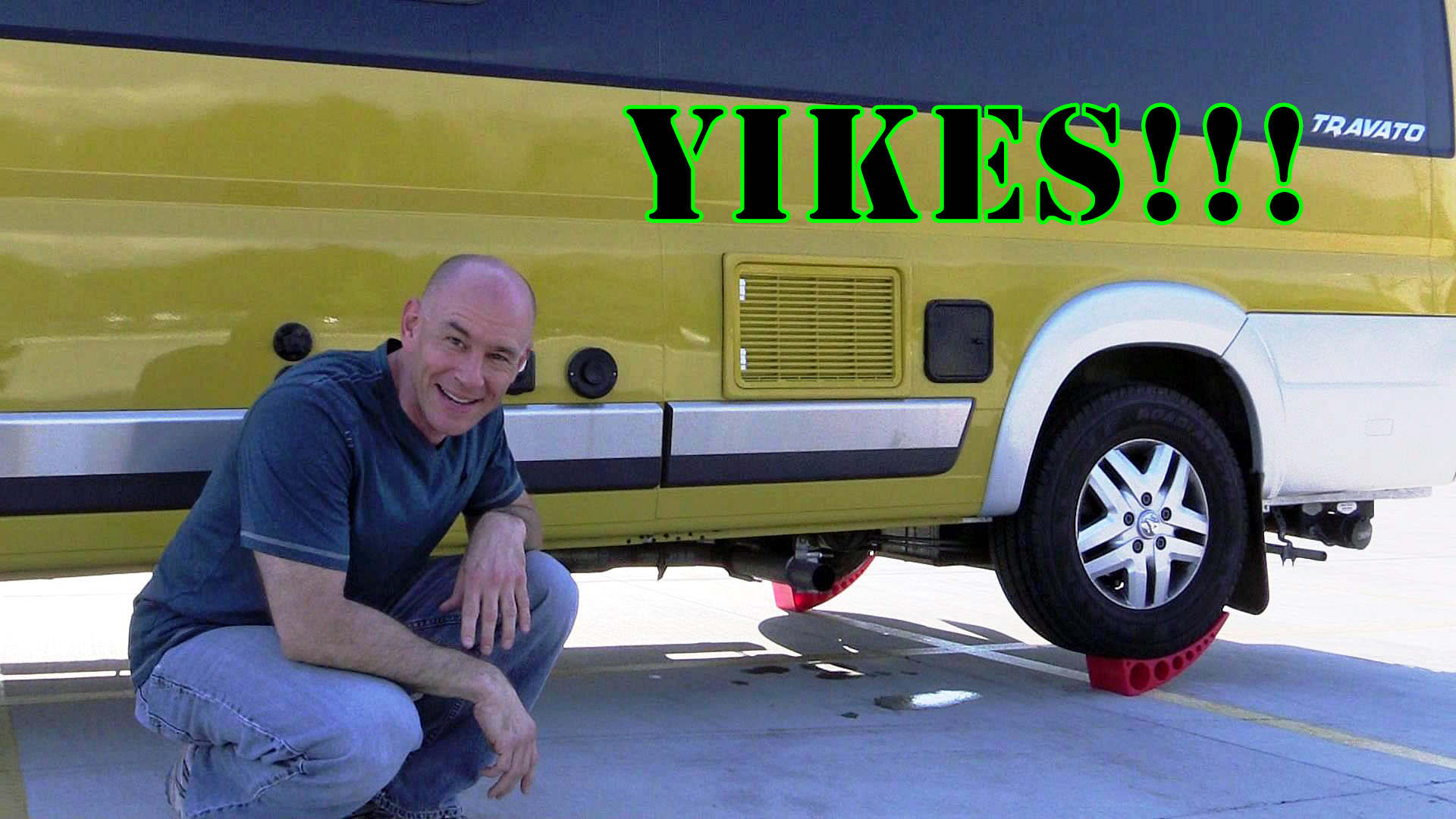
Stef will tell you: Not every idea I have is a good one. Take this one. I had high hopes for being able to use the Anderson Camper Levelers to level up our Class B easily. I set myself up with accessories, made some handy reference charts, and had what I thought was a solid process outlined in my head. But when I bought the levelers and tested everything out, it didn’t really work. Have a look at the video and you’ll see what I mean.
For those of you who want a little more detail, here’s the write-up.
The idea was pretty simple.
- First – I found a smartphone app that provided me a surface level. Besides giving me some basic info about the angle of the rig, it also had a “beeping” feature. The beeps get closer and closer together as the device approaches level.
- Next – I found a place near the driver’s seat where I could put my smartphone so that the level app would give me the same reading that it does when sitting in the refrigerator.
- Then – I figured out how much tilt I was willing to live with (in my case, 1 degree).
- Using some basic trigonometry, I made a chart of how much lift would be needed to correct for various angles. This was done mostly as a sanity check and a safety measure. I did this in a spreadsheet. If you know the wheelbase and track of your vehicle, you can use the spreadsheet as well! You can download it from here: Wheelbase Track and Level
- Then, I purchased the Anderson Camper Levelers. I paid full Amazon for these. The reason I wanted these is that they provide a continuous spectrum of lift. Unlike stacking blocks (where you can get either 1 inch or 2 inches of lift), the Anderson levelers could provide 1.32785″ of lift if you want. The amount of lift depends only on where you stop.
I’ll be honest – I had visions in my head of driving smoothly up onto the levelers, and gliding to a stop when the beeps from my smartphone changed pitch. It was a great mental visual. Unfortunately, it didn’t work out that way at all. There were a number of problems with this system, none of which I really blame on the Anderson Levelers.
Issue #1:
Driving up onto these levelers is tricky. In the video, you’ll see me drive up onto the levelers multiple times. None of these attempts are smooth (and there were about 30 attempts you don’t see on the video, so it’s not like I didn’t get plenty of practice). There was a lot of two-pedal driving trying to keep from rolling backwards. And trying to move a nearly 5 ton vehicle uphill in half-inch increments isn’t smooth – it’s jumpy and jerky. As you can see, I was trying to move the RV through what was basically 1/8 of a rotation of the wheels and tires.
Issue #2:
These levelers are designed for travel trailers and fifth-wheels, not motorhomes. Think about that one for a minute, because I didn’t think about it before I bought them. Picture your typical single-axle travel trailer. There’s NO WAY to level this front-to-back by raising or lowering a wheel. Here’s a very crude diagram to help you visualize it.
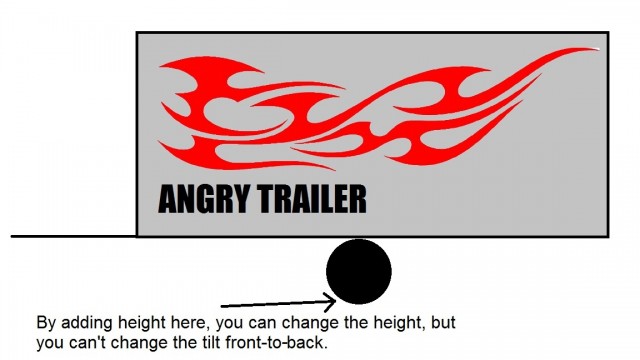
So, with that in mind, now think about a typical Class B. We level front-to-back all the time. We also have two sets of wheels.
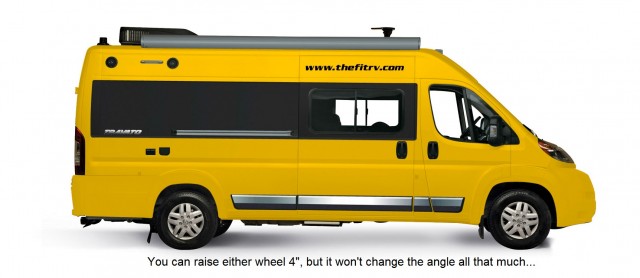
So, even though the Anderson Camper Levelers can produce up to 4 inches of lift, due to the long wheel base of a Class B (compared to a camper), that four inches of lift will only change the angle of the RV about 1.5 degrees front-to-back. My spreadsheet predicted that, and the testing proved it right. Campers don’t really level front-to-back this way, and so that’s not a problem for them.
Where these levelers work well is in leveling things side-to-side. There’s not much difference in width between a travel trailer and a Class B. We all have to share the same roads, which keeps widths in check. We got double the amount of angle correction side-to-side that we did front-to-back, both calculated and in testing. So for side-to-side leveling, I had no real problems.
Issue #3:
There’s a potential damage issue in using the Anderson Levelers with a motorhome. In the online videos for the camper levelers, they simply drive right off the fronts of them. I guess for travel trailers and such, this is OK. They ride a bit higher up than our Class B does. I never tried to run off the front of the levelers with our rig. I’m pretty sure I would have damaged something if I had. You’ll see what I mean in the video. The leveler is a solid block of stuff about 18 inches long. You don’t want to throw that around the wheels of your vehicle. This severe penalty for an error I could easily see myself making was a big turn-off.
Issue #4:
The levelers are just a bit too big for us. You see, blocks, you can take apart, stack, unstack, or do whatever you need in order to get them stored. The camper levelers are all one piece – they don’t break down. And in our rig, with limited storage space, that really caused a problem. Again, you’ll see that in the video.
I’ll repeat – I don’t blame the levelers for any of this. For a camper with adequate storage that you only need to level side-to-side, I’m sure they’re fantastic. But for our Class B, with limited storage, and which we need to level in both axes – they just didn’t work.
But it’s not all bad news! I’m going to keep some of the other parts of the test. For example, the surface level smartphone app was a keeper, and it will help in the future in those situations where something doesn’t feel right. And thanks to the work I did here, I’ll even know where to put the phone! Also, my lift chart will come in handy for determining the number of blocks or boards I need to put under a wheel to get me level in the future. I’m printing out a copy and sticking it in the glove compartment for future reference.
So while the ultimate daydream of leveling smoothly by ear remains an elusive fantasy, I’ve at least got a couple more tools I can use when we go RVing. That was my weekend project. Hope you liked it!







Thank you for illustrating this. I am attempting a long solo trip and will need to level solo. For laughs, check out Rick & Morty. True level!
https://youtu.be/Q1zBtJhgwBI
OMG! YES!
THAT… **THAT** is how I feel about being level.
I’m sure it takes some math to figure out how much lift you need for your RV, like you said. It’s important to make sure it’s leveled correctly. I want to get an RV, but I might just hire someone to make sure it’s leveled correctly.
These are amazingly easy to use. Plus they have a great lifetime warranty. I broke one somehow. Emailed Anderson a picture and ups delivered a new full set 3 days later !! No questions asked !!
Glad to hear they stand behind their product.
Still don’t think they’re ideal for leveling a van, but if they’re working for you, then roll on!
James! I run solo. I LOVE YOU for doing this! I have a TT so i am kind liking them? Maybe? Humm…
For a TT, they would work quite a bit better than they did on our motorhome.
We have the Andersen leveler, had used them for quite a while. Then I was removing the chock from between the tires and the chock sucked my hand in and about tore it off. This was 7 weeks ago and I still have about 6 to 9 more months of healing. So be careful with these.
Oh my word! I am so sorry to hear that!
That is a type of danger I never considered when reviewing these.
We hope you heal up properly and are back at 100% soon.
At first we really liked the simplicity of the Anderson leveler since in our Trend Promaster we tent to only need to level side-to-side. All was going fine creeping up and backing off until one time, then SNAP — it cracked in half. Back to the blocks now.
Yikes! They seemed pretty sturdy to me, but I only used them for a weekend.
You are reinventing the wheel with the calculations and all. As others have noted there are apps that do the calcs for you. For an Android device there is “Camper Leverler” and “RV and Trailer level”. Camper level gives you the amount, in inches or cm of how much low or high you are at each wheel, after you set up the track and wheelbase of the vehicle and calibrate it on a flat solid surface such as the floor.
Camper Leveler is also available for iphone.
http://apk4ios.com/APK_Camper-Leveler-Free-Edition_iOS.html
Yes, there are apps to do this. Honestly, I thought the math was fun. (I’m weird that way.)
Anyway – the Truma app is the one that we use.
If you haven’t seen our subsequent testing of the LevelMate Pro, you should check it out.
I was wondering what the iPhone app to level is?
This one!
https://itunes.apple.com/us/app/truma-app/id908729646?mt=8
Hi James,
I’ve watched quite a few of your videos over the years – thanks for such great content! My family is for the moment full-timing in an old 1978 19′ Class C, and we’ve been thinking about leveling options. If you have a 12v compressor to bring with to campsites/boondock locations, you could make your own airbag levelers with old firehose: https://www.youtube.com/watch?v=x19Wsx2OSz8. Check out 9:00 to see it in action; the first 8:59 are pretty much the build.
Interesting… I wonder how stable they are in use. As in – would the RV “wiggle” while perched on top of the air bags?
Also – wondering what the max height you can get from them would be.
Cool idea though!
Hmm So you must use the absorption method of sleeping. Six degrees off level and you will actually burnout! lol I think the compressor method is better, I find I have no gas in the morning and am charged up and ready to go.
Interesting analogy! I’m probably more sensitive than the refrigerator, actually.
I’m a millwright by trade and level things for a living. I’ve always just held a 2′ level level and then measured the gap at one end. Then a little ratio math and i know how much lift I need under that wheel.
With a bunch of kinda complicated math you can take both your for/aft and side to side measurements once and figure out what the 3 low tires need.
I say complicated because I didn’t have a spreadsheet.
It *should be relatively easy to write a spreadsheet formula that you can input the degrees from your phone (tho I personally don’t think it has a big enough footprint to be accurate) and know exactly how much lift for each corner.
I have an untried drawing of some home made lego blocks that are both lightweight and strong enough for tractor trailer use. If you’re interested I can dig up the drawing and send it via the method of your choice.
I never tried them because I sold my camper and bought a tandem axle 5th wheel. They need a small adjustment to work with the tandem axles.
There are apps for smartphones that do the calculations for you if you enter the track and wheelbase of your vehicle. Truma makes one.
Then there is “the next level” of level (pun intended).
This week, I’ll be testing the “Level Mate Pro”. Expect a video soon. It doesn’t level the vehicle for you, but gives you the information you need to do it through some other means (blocks, jacks, etc.).
LevelMatePRO vehicle leveling system. Gives you actual inches of lift at each wheel… I use it on my truck camper and it is great..
Is that actually an automatic jack system, or is it something that tells you how much lift to provide on your own with blocks, etc?
I had the same thought! Just found your youtube channel and enjoyed the in-depth composting toilet video – thanks for being detailed about the nitty gritty details. But for leveling, I think you would love the LevelMatePRO! It’s a device you mount and calibrate once, then it talks via bluetooth to your phone or tablet and tells you in real time how level you are an what you need to do at each tire to rectify it. I first saw it on a video by RVGeeks.
I actually tested out the Level Mate Pro, and it’s installed in Lance now! Check out my review!
Being new to RVing I bought the Anderson’s for class C and thought it would be great. Had the same results that you had and terrified of driving off of them. So glad it was not just me. Liked your math, it is not my strong point so you talked way above my math knowledge. However I did find an app called Truma that I think does your math and what your iPhone does to level your RV. Requires a little measuring of wheels but one you plug it in you’ve got it. Thanks for all you do, as you know RVing is a learn as you go, and what you don’t know does kill you or at least your wallet on the fixing.
The Anderson Leveler is the cat’s meow for leveling of my travel trailer.
Yeah – I figure they work great for something with the axles in the middle instead of the ends.
Nice analysis and demo, James — thanks! I use the Andersen levelers with our Sprinter motorhome, but in combination with the Hosspads that you show in your video. I position an Andersen on top of the Hosspads to give me extra lift without having to drive all the way to the edge of the Andersen. The firm rubber of the Hosspads also eliminates slipping on slick or unstable surfaces like the gravel in this photo: https://www.dropbox.com/s/myp2chuqlqjvn6a/Andersen-Hosspads.jpg?dl=0
Well that’s not a bad idea!
You get another inch with the Hosspads right off the bat. More to carry, but it seems safer to me than driving all the way to the tip of the Anderson Levelers.
Thanks for sharing!
Now, I’m wondering if anyone with the Andersons has figured out how to solve the staggered height issue – where you want to raise one wheel 1″ and the other 2″? I know you could measure and such, but I don’t know if that would hold up when you put them down in gravel.
I use the Truma app. You enter your vehicles track and wheelbase and it tells you how low, in inches, each corner is. Works great, and it’s free.
Yep – Truma app is basically the same thing as my spreadsheet and level app – it just does the lookup for you.
I’d still recommend playing around and finding the right place to put your phone so that it mirrors the fridge or bed.
It occurred to me while you were placing the iPhone — if you needed to place it in a spot where you couldn’t hear it too well, you could pair a Bluetooth speaker to the iPhone and put the speaker next to you.
Never thought of that, but yes!
With that setup, you could even put the phone IN the refrigerator.
(Just don’t forget and leave it there…)
I would add potential issue No 5: In soft terrain, I’m willing to bet it will dig in and sink if you get get anywhere near the maximum lift. Look how small a surface it is sitting on once you get it up on it’s tippy toes. If it sinks, you won’t even get 4 inches, and depending upon the geometry, your wheel might fall off the front, which was something you wanted to avoid.
I’ve had wheel chocks sink in sandy terrain and the trailer moved as I was unhitching it. Almost cut off a finger.
Like some of the other posters, I have used my one Anderson leveler many times and been relatively pleased. I am like you and get dizzy when off level and my partner could not care less! Anyway… I do it one person more by feel but it’s been pretty good about getting me pretty close. I know that is not perfect, but it works for me. I have to admit that I have never tried the lego blocks so I have no comparison, but I do like the ease of this system and I have room for it… Question is whether I need to buy another one!
I have the Dynamax 24RB by the way…
If you need another one, I may have two that I’d be willing to part with… just sayin’. 😉
Do you still have those Andersen levelers you would like to part with?
Actually sold them locally. Sorry!
Cool app, I’ll use it to tweak the angle of my bike seat.
HA!
(Never thought of that one…)
What’s the leveling app?
I posted a link in another comment.
Leveling being very important, why don’t fridges and RVs come with built-in levels? (Rhetorical question, not looking for an answer.)
You can take your wheelbase and track, the data from your level app, and use a spreadsheet to calculate the exact lift required at each corner. Then you can assemble blocks (I use recycled rubber treads) to make the lift once. However, it’s never going to be perfect because the suspension will react.
The ultimate would be to replace the steel springs with air suspension, and have the rig balance itself. I have seen class As do that.
Oh, one more issue. Tire manufacturers recommend that the entire width of the tread be supported; RV tires are wider than trailer tires.
I daydream about having four corner independent air suspension that I could use to level the rig. VB actually makes an air suspension for the rear of the ProMaster (it completely replaces the factory suspension back there). But they didn’t have anything for the front last time I checked.
Good point on the tire width. I didn’t like the small contact patch when I was up at the peak of the levelers. The narrow width of them only compounds that. That whole weight/area thing again…
Hi James-
It’s nice to see a piece by you on the Anderson levelers-they are about as rare as the Sewer Solution out in the world and more people need exposure to new and different ways to do things!
A fellow in my camping club uses or at least purchased a set of the Anderson levelers last year for his 5th wheel. I need to ask him how they worked out. I have been intrigued since I saw them awhile back and the promise of drive-on (once!) leveling is very attractive. Unfortunately, on our new rig (a travel trailer), the wheels are so close together I don’t know that I could even fit them in to start with!
Your point about front to back leveling is right on. Travel trailers and 5th wheels have an independent means to level that way that motorhomes and pickup campers do not (unless they have leveling systems).
One last thing-I’m curious about this line; “These levelers are designed for campers, not RVs”. I hear that distinction made sometimes and I always wonder about it, seems a little backwards. Aren’t most of the things we talk about RVs? (The Genus) and then we can have motorhomes (A, B, B+, C), travel trailer (awkward, but “bumper pull”) and 5th wheel and then pickup campers (the various Species). A small thing, but I wanted to at least mention it.
Thanks again for all you and Stef do in this niche of the RV universe!
You got me!
RVs include travel trailers and motorhomes. I’ll go back and edit the article to say “campers, not motorhomes.” Thanks for calling it out.
I agree, the Andersen’s are best for travel trailer side to side leveling (the tongue jack handles the front to back).
For our truck camper we use two of these that my father built for us 20 years ago. He used 2X8’s which gives us a 2″ – 4″ – 6″ lift options.The bottom 2 are permanently screwed together. The top one is rarely used, so the screw just drops into an over drilled hole when needed. The front end of each board is beveled so it’s easy to creep up to the next level.
Like the Andersen’s it is a single piece (no stacking) and they are easy to store. In the worst of situations it has never take more than 5 minutes to level up!
________
|________\_________
|__________________\________________
|___________________________________\
Happy Trails
Andy & Kim
Hi Larry –
I made a set of wooden blocks just like you describe! I even put chocks at the high end to keep from rolling over. I use them in my driveway when I need to work underneath the RV. The ones I made are a bit too big and heavy to really take with us.
Larry?!?!?!
Hmmm …. If he’s younger than me I’ll take it!!!!!
Happy Trails
Andy
And now we see why I shouldn’t try to approve comments when I should be working… Sorry!
If the 2 key places to keep level are the bed and the fridge, why hasn’t anyone come up with a way to level them independent from the rig? Raising and lowering furniture legs would be simpler than trying to level a 5 ton RV.
OK. Larry – that’s actually a really good idea.
Let me think about that one for a while…
I have the Lemondo bubble level on my phone. I put it on the dining table in my G and it’s close enough for government work. I originally carried two 10 block sets of Legos in my Stowaway. The first time I used them they started to crack. I bought two of the Anderson levels and installed “stair tread” on them per a suggestion I had seen on some forum. So I’ve been carrying them plus one of the two sets of Lego’s (in case I need to go higher than just the Anderson’s will go). I recently stopped in a campground that gave me reason to raise the front end about 4″ – a perfect first use. Stuck those puppies up against the wheels and drove forward. Wife told me when I was at the precipice. Put the chocks in place. Worked fine. Test 1 gets an A.
Glad you’re happy with them. I didn’t show the chocks in the video because I never stayed parked long enough for that to make sense. But yes – everyone – if you use the Anderson levelers, please use the chocks!
When I was up on the precipice of those things, I thought “there’s no way I’d leave the tires like that for more than a few minutes.”
It just didn’t seem like enough of the tire was supported when I was that high on them. It’s that whole weight/area thing. Lego blocks seem like they offer a bigger contact patch and therefore spread the tire’s load better – at least at the 4″ end of things.
Anyway, if it’s working for you, who am I to argue!
What leveling app did you use?
The app I used was an iPhone app called simply “Surface”.
It doesn’t seem to be available any longer in the iOS app store.
That was a great video. I was thinking the same thing, if you drive off the front of those you are probably going to do some damage. They scare me.
Question, you seemed to imply you would never use more than two of the blocks, why is that? I have a View and carry two packs of 10 Lynx blocks. I use them in my own driveway, which is a good bit off level side to side and front to back. I put a stack of three under the front left wheel and it gets me in less then 1 degree side to side and front to back. I build a pyramid so that the tire never has to climb more than one block at a time. Why do you never use more than two?
Thanks for the great videos!
Well, we never use more than two because we never carry more than four! That’s honestly all.
In our Sprinter before, we had more room, and we carried a full complement of lego blocks. (And I would go more than two high.)
But I’ve just not found a place to store them that makes me happy in our current rig.
I love my Andersen levelers for my Sprinter NCV3. I have three of them and have found that one you get used to them, levelling is a breeze. I have driven off them many times and have never had any damage to my rig by doing so although most times I just back off them. Also, mine came with an additional wedge shaped chock piece for when you have to use them to the maximum height. Why didn’t you show that in your video? Other then your assessment that they take up more storage then your rubber pads, I think you got over ambitious in trying to analyze them. Next time try going to a campsite and test them instead. You might find them for useful then you thought.
Hi Mark!
Well you’re probably right about being over-ambitious trying to analyze them… But then, that’s sort of my thing! 😉
We had a T1N Sprinter before our Travato. It rode a good bit higher up, I doubt I would have hurt anything on Das Bus by driving over the levelers. The Travato rides closer to the ground, and I wasn’t going to try it with my own rig!
And yes, ours came with the chocks as well. I was only parked in those different positions for a minute or less each time, so busting out the chocks didn’t make sense. But if you were going to stay awhile, yes, the chocks are definitely recommended.
i feel your pain.
give a look at http://www.rv-boondocking-the-good-life.com/rvlevelingblocks.html
we carry a small, cheap “bubble level” (about the size of a quarter) which gives me the general ‘situation’.
I have one of those. As long as you calibrate your level to your fridge, I think that would be fine.
Except it won’t beep at you… 😉
@ Commentor James That’s a pretty good idea. They would be too heavy for our situation but a great long term solution for rigs with the CCC to spare.
@Fit James Thanks for another great post and video.
You’re welcome!
Excellent experiment and demo. Thanks!!!!
Long time listener, first time caller:
How strong are those levelers? What if you flipped them over and drove up the hump? That would give you a bit more height.
Honestly, they seemed pretty strong.
I don’t know if I would trust my rig on them if I drove on them in a way they weren’t designed for. I could envision the arch collapsing if I were to try what you suggest.
It might work, but I’m pretty sure Anderson would say “all bets are off if you use them that way”.
So I didn’t try it. And likely won’t. At least, not with my rig…
1st, James, good video for onew od your regualrs. Paul, Anerson’s website says for RV’s up to 30k..therefore 15k//chock. I/ve purchsesd…only palyed w/in driveway. WE have a 59K TRAVATO (twin-bed)…which replaced our 15y/o RIALTA. W/both RIALTA & TRAVATO we use a STOWAWAY box, so we have space for Lego block levelers. However, I’m optimistic about these Anderson levelers.
Check this out… I have bought these for every rv I have owned. http://www.hopkinstowingsolutions.com/products/levels/two-way-graduated-never-fade-level.html
No chart or iphone required.
Rob
Yep. I thought about getting something like that. But I would want it mounted where it was visible from the driver’s seat and I just couldn’t figure out anything I really liked.